

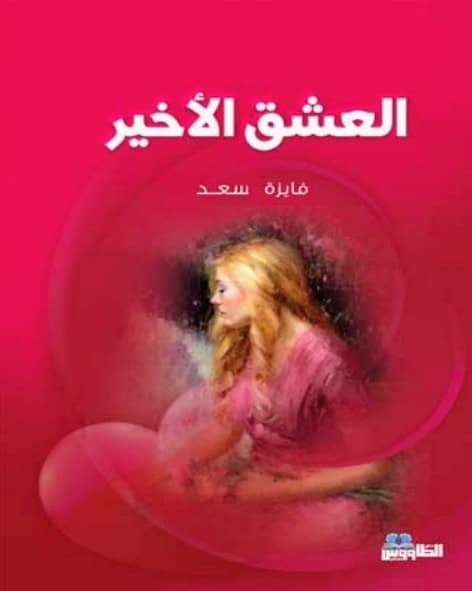
The Beautiful Ache in (The Last Love) by Faiza Saeed
Yemenat
Mohammed Al–Mekhlafi
Faiza Saeed is a Saudi poet who belongs to a generation of Saudi writers, both men and women, who have established a strong presence in the Arab literary scene through serious and coherent creative experiences.
This generation approached literary texts as human experiences before considering them formal exercises. It distanced itself from ease and repetition and presented a diverse and rich image of the Saudi cultural landscape.
She has published several poetry collections, beginning with (Anthem of Desire) in 2005, followed by (Half an Apple) in 2006. Her poetic output continued until the publication of (The Last Love) in 2021, which remains her most recent collection and the work examined in this study as an advanced milestone in her poetic journey.
From this perspective, my reading of the collection is a personal one. It does not arise from preconceived critical assumptions, but from the experience of a reader who enters the text, becomes entangled in it, and reshapes his expectations with every page.
When I began reading (The Last Love) by Faiza Saeed, I did not expect more than familiar love poems, those that usually begin with a call and end with a sigh of regret.
I assumed I was encountering another emotional collection that I would read quickly and then set aside once finished.
However, from the very first pages, I realized that I was facing a different experience, one that does not merely confess, but gently draws the reader into a deeper space, resembling an existential journey written in the language of love.
The collection, published by Tawous Publishing House in Saudi Arabia in 2021, consists of 321 pages and includes seventy-five poetic texts. It opens with (You Are the Morning) and closes with (Our First Love).
This arrangement did not appear accidental to me. As my reading progressed, I felt as though I was moving within a circle: the wonder of the beginning, followed by involvement, then pain, and finally a return to the first love, or perhaps to its memory.
Why this circular structure? Did the poet intend to suggest that love does not move in a straight line, but instead always returns to the same point, no matter how much we attempt to escape it?
From the opening pages, one notices the collection’s liberation from classical constraints. There is no traditional meter or rhyme.
Yet I never felt that the poems were loose or lacking rhythm. The rhythm is internal, emerging through repetition, the succession of images, and a long breath that resembles an exhalation after prolonged restraint.
Some critics may view this freedom as a structural weakness. However, as a reader first and foremost, I felt that this choice was intentional, reflecting the nature of love itself as chaotic, volatile, and resistant to regulation.
I read most of the collection late at night from a PDF version on my phone. What drew my attention were the white spaces between the passages.
They did not seem like empty gaps, but deliberate pauses, moments of silence. It was as though the poet left space for the reader to place their own pain, reflections, or even hesitation.
On several occasions, I paused before moving to the next line, not because the meaning was unclear, but because it was emotionally dense and required time to be absorbed and processed.
In (The Last Love), language is not merely a vessel for emotion; it is the emotion itself. Words, letters, the body, and time all write and are written.
When the poet says:
(In your love I write
and my eyelashes write
and my lips write and my pen writes
and my body writes) (p. 90)
I felt that writing here is performed not with a pen, but with the entire body. Some poems appeared to me like wounds bleeding ink, as if the words were not written on paper, but stitched into memory with a needle.
At first, I believed that love in the collection was individual and self-contained, limited to an (I) and a (you). As the pages unfolded, however, I discovered that love expands to encompass time, language, and even the homeland.
This reminded me of Adonis’s statement (Poetry is a stance toward existence), which I found clearly embodied in this collection. Love here is not simply a relationship, but a way of seeing the world.
Femininity runs through the entire collection like a hidden thread. It is impossible to read these texts without sensing a flowing femininity between the lines.
This femininity is not decorative or slogan-like, but an inner structure of the text itself. Initially, I was struck by the repeated use of the word (woman), but I later realized that it was not repetition so much as a gradual construction of identity.
I am not certain whether this insistence aims at emphasis or affirmation, but in every case, femininity here becomes an act of writing rather than a subject written about. At times, I felt I was reading a textual body rather than a conventional poetry collection.
Decision, understood as a feminine act, was among the most compelling themes for me. Decision here is not a passing detail, but a moment of sovereignty.
The woman in the collection chooses, even when the choice is painful. This is what gives love its persistent association with loss. Love does not exist without risk, nor is it written without pain. When ink turns into blood, creativity ceases to be merely aesthetic and becomes an experience of real bleeding.
All of this intersects with the notion of homeland. In some poems, the homeland appears as a besieged woman, lonely and trembling. This led me to wonder whether the poet speaks of a specific homeland or of every woman living under the weight of oppression. Perhaps she speaks of both at once. Patriotic love here is not an anthem, but an ache.
The invocation of the myth of Adam and Eve adds a powerful metaphysical dimension, presenting love as the first sin and as an inescapable fate.
(Love is like war, there is no choice in it.)
This line made me pause. Do we truly choose love, or are we thrown into it as a soldier is thrown into battle?
The body in this collection is not fixed. It transforms and merges with nature, becoming a tree, a flower, or a sea. This transformation reflects the fluidity of the lover’s identity. In love, we do not remain who we are.
The collection reaches its climax in what resembles an elegy for love:
(Your love was my first sin on earth, and my last sin on earth) (p. 300)
Here, everything returns to the beginning. The circle is complete. Light and loss, guilt and forgiveness, beginning and end all converge at a single point.
I admit that some texts resisted me on the first reading, forcing me to return to them. Yet perhaps this resistance is part of the beauty of the experience.
This is a collection that cannot be read hastily or consumed in a single sitting.
A text from the collection
(Our First Love)
My story with you
a stormy morning
my bitter cup of coffee flooded
with a traveling sorrow
in a day without
addresses.
At the bottom
of the blue cup
I caught sight of my first story with you
when that evening washed
our first voices
with water and cold
and we planted, among the stars,
two lovers.
Guests of the moon
stripped of all
its garments
naked except for its blazing light
lavish and generous
to the farthest planet
to the farthest galaxy
as it offered us
the drink of love.
I finished reading (The Last Love) feeling as though I had shared with the poet Faiza Saeed a portion of her beautiful pain.
This experience is not measured by strict adherence to form, but by its ability to make the reader feel, question, and become entangled. Here, love becomes an act of writing, and writing becomes, quite simply, a means of survival.