

The Village – My First School
Yemenat
Mohammed Al–Mekhlafi
The village was my first school. There, I learned that dreams can grow even in the narrowest of spaces, and that the faint glow of an oil lamp can illuminate a long road of ambition.
Every story begins somewhere, and mine began with my friend, Abdulmalik Abdullah Qasim Al-Qadhi. He was a calm, kind-hearted young man—intelligent, well-mannered, and as captivating as a fine book. The more time I spent with him, the more fascinated I became by the chapters of his life. His company was never dull, never tiring.
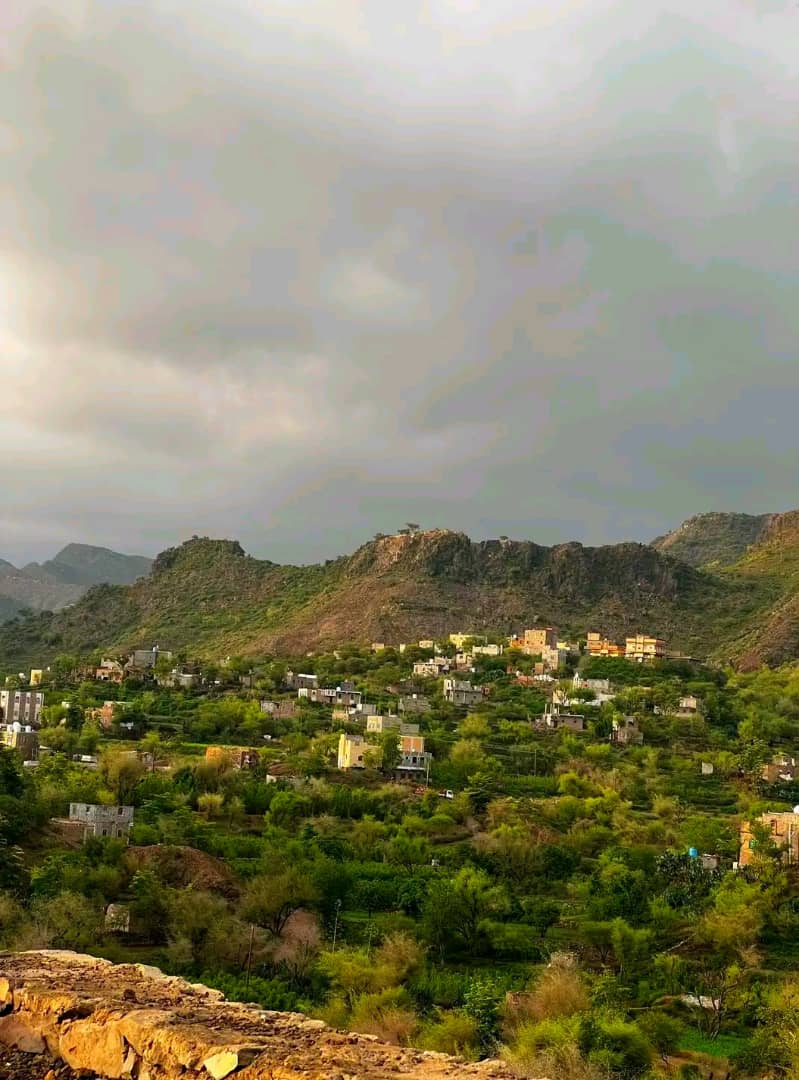
After finishing junior high school, we both moved to Salah Al-Din School in Al-Husain to pursue our secondary education. We used to study together in an unfinished house at the entrance of his village, Ruba’aʿ, which lay close to my own village, Kinda, in Mekhlaf Sharab highlands north of Taiz.
There, between half-built walls and the open sky, our dreams grew taller than the surrounding mountains. We imagined that once we completed high school, we would move to the city—to work, join university, and study English literature. We dreamed of a different tomorrow, one filled with opportunity and purpose.
From noon until sunset, we did nothing but study, discuss, and dream about the future. Then I would bid him farewell and walk back to my village. Upon arriving, I would head straight to my grandmother Mohsana’s house—may God’s mercy be upon her. She had taken me in after my mother’s death, when I was not yet two years old. In her home, I found warmth and a simple meal, often sourced milk with (Kadir) a piece of rustic homemade flatbread.
My grandmother Mohsana was the cleanest woman in the village and the most gifted at baking kadir, our traditional flatbread. After dinner, we would sit in Al Darah—the courtyard of our old homes—listening to the grandmothers’ tales beneath the stars. When drowsiness began to weigh on me, I would retreat to my small adjoining room and sleep until dawn.
After the morning prayer, I studied by the dim light of a homemade lamp—an empty brake-fluid can filled with linseed oil. I would twist a strip of cloth into a wick, dip it into the can, and set it alight.
The lamp’s glow was feeble, barely revealing the lines in my notebook, yet its smoke was thick and suffocating, stinging my eyes and burning my lungs. Still, I endured it, reading until the first light of morning.
Then came the time when illness changed the course of my life. My father was diagnosed with cancer and taken to the city of Taiz for treatment. But his condition worsened, and he never returned—except as a lifeless body.
I still remember that Saturday morning as if it were happening now. I left home early to sit for my first-year high school final exam, my heart clenched with fear for my father.
I had visited him two days earlier. I found him broken, his eyes filled with tears as he looked at me—as though he already knew they were his last glances. I left him weeping, my own heart bleeding for him.
When I reached the edge of the village, near the cemetery, a sedan had stopped there, surrounded by a small crowd. I approached with hesitant steps until I heard someone say, “Saeed Abdo has died… may God have mercy on him.”
I couldn’t hold myself together. I burst into tears, unable even to take one final look at my father’s face. Somehow, I steadied myself and continued on to school. I boarded a pickup truck heading to the market of Al-Husain. One of the passengers asked, “Who passed away?”
I wept in silence, unable to speak.
When we reached the market, I sat beside a shop, tears streaming down my face. My Egyptian teacher, Ashraf—a devout and kind-hearted man—noticed me. He approached gently and asked, “What’s wrong?”
Shaking, I replied, “My father has died.”
He took my hand and led me to his quarters near the school, trying to comfort me. Sitting beside me, still holding my hand, he said softly, “You must stay strong, be steadfast; this is life’s way. One day, we must all depart. May God have mercy on your father.”
He offered me breakfast. I ate with him, and then he took me to the school.
While the people in my village were busy with the burial, they kept asking, “Where is Mohammed?” They thought I had run away. Some of the young men were sent to search for me until they found me sitting in the exam hall.
May God’s mercy envelop my father. He left a vast emptiness in our lives. He was gentle and kind; I cannot recall a single day when he struck or scolded me. Instead, he always encouraged me, always urged me to study.
I remember, as a child, gazing at his face, memorizing every feature, whispering to myself, If my father dies, how will I live without him? And then, silently, I would cry so that no one would notice.
My mother—may God have mercy on her—departed early, when I was barely two years old. I never remembered her, never knew her except through the image I built in my imagination—a picture of her face drawn from longing rather than memory. Even now, in my mid-forties, that tender image of my mother still lives in my mind—untouched by time, unchanged by the years.
That difficult year, I ranked sixth among the top students. I was diligent, curious, and imaginative—a boy who loved reading and learning. Whenever the teacher explained a history lesson, I would see the events unfold before my eyes, the characters taking shape in my mind as if I were watching them on a television screen. That imagination helped me understand, and even more, it made me love learning.
I was deeply passionate about English. The textbooks were never enough for me. I listened to BBC educational programs and another show hosted by Ahmed Omar Bin Salman on Aden Radio—his distinctive voice still echoes in my memory.
Sometimes I borrowed short stories from my friend Wael Mohammed Ali. I would read them hungrily, feeding my imagination and enriching my language.
My aunt Na’aym—may God preserve her—lived in Saudi Arabia. Every Ramadan she sent me a small amount of money to buy new clothes for Eid. But often, instead of spending it all on clothes, I would travel to Taiz, to Jamal Street near the Education Office, where there was a small bookstore that sold English books, stories, and novels.
I would buy a few, return to my little room, and spend hours reading—lost in those pages, never feeling tired or bored.
I still remember one blazing afternoon when I walked nearly three kilometers under the scorching sun to visit Dr. Ali Sarhan Al-Mekhlafi in his village, Al-Shajerah. I asked him to write me an essay about the importance of the English language. As he spoke and wrote, I watched him closely, imagining that one day I would be like him.
Later, I would meet him occasionally in Al-Husain market, the heart of our region’s gathering place. I spoke with him in English every chance I got—it filled me with joy and pride.
Once, I met him around noon. I greeted him and began speaking in English, but he seemed to be in a hurry. I followed him, talking as we walked. Suddenly, he stopped, a little annoyed, and said, “Don’t be so meticulous.”
I asked, “What does that mean?”
He smiled and said, “It means don’t focus too much on the tiny details.”
I said, “Write it on my hand.”
He laughed, wrote it, and walked away still chuckling.
When the final high school exams approached—they were held in Taiz City at that time—my friend Abdulmalik and I contacted Abdullah Faeed, who was then in his last year at university. We asked if he could find us a room to stay in during the exam period. He told us we could use the room he was about to vacate.
Two weeks in Taiz meant expenses, and I didn’t know how to cover them. I told my grandmother Zahra—may God rest her soul—about my situation. She managed to gather 2,000 rials to help me through that period.
Two days before the exams, we arrived in Taiz. Abdullah met us at Sharab Al-Salam car station and took us to the building where he had been staying—Ali Madarah’s building in the Old City, near Al Bab Al-Kabeer.
The room was on the third floor—small, about four by three meters, dark, windowless, and without a bathroom. There were five of us sharing it. I had brought a small kerosene stove from the village; we used it to cook our meals. After eating, we would gather the plates and the stove into a sack, tie it with a rope, and hang it from a nail fixed to a wooden beam in the ceiling.
I remember my friend Abdulmoaen Othman Ahmed going to the market on Friday mornings to buy chicken pieces and rice. He would return before noon so we could cook lunch. We’d pray the Friday prayer, then buy Qat, have lunch, chew together, and continue studying through the afternoon.
When we needed to use the bathroom, we went to the ancient Al-Mudhaffar Mosque, built in the 13th century. The bathrooms had no doors—only old stone walls and dim light.
One night, before the dawn call to prayer, I went there. The lights were weak and flickering. As I stepped inside, my foot pressed down on something soft—it was a madman sleeping on the floor. Terrified, I ran all the way back to our room.
As I hurried through the narrow alley, I felt footsteps behind me—someone was following fast. My fear grew, and I started running; he ran too. I reached the building, rushed upstairs, and burst into the room—he came in right after me, laughing. It was my roommate.
Every day, I studied with my friends until around five-thirty in the afternoon. Then I went to Souq Al-Shanini in the Old City, where I met foreign tourists and spoke to them in English. Those conversations were moments of pure joy for me.
At sunset, I prayed and returned to the room. In the mornings, we walked long distances on foot to reach the exam center.
A day before the final exam, just before sunset, I was at the market. It was drizzling lightly when I suddenly heard someone calling my name. I turned and saw my friends from the village. They said they had been looking for me for two hours.
We sat by a shop, and they told me they had caught an Osaq—a fox—in our village and that it was tied up on a bed in Al-Nile motel on Tahrir Street.
I was puzzled. “What do you want me to do with it?” I asked.
They said, “Word has spread through the villages that Al Osaq is a cure for AIDS. We want you to sell it to the foreign tourists.”
I asked, “Are you sure that’s true?”
They replied, “Yes, everyone’s talking about it.”
So, under the gentle rain, we went searching for tourists in the market. I spoke with them in English, trying to convince them that the fox was a cure for AIDS. They laughed and shook their heads. For more than an hour, we wandered through the crowded market, hearing the same amused refusals.
Finally, I said, exhausted, “Tomorrow is our last exam.” I apologized to them and went back to the room.
After we finished the exams, we returned home at noon, full of joy. I still had eight hundred rials left from the two thousand. We went to the market and found a shop selling clothes and shoes at cheap prices. I bought myself a pair of trousers and shoes.
Back at the room, I put on my new trousers and shoes, along with my beige coat, and went out with my friend Mahmoud Saeed Al-Bahri to the park. We took photographs to remember those days.
The years have passed, and life has taken us down different roads. Yet what remains within me is the echo of those days—days that taught me that poverty is no barrier, and that dreams and determination can give life its true meaning.