

When Language Becomes a Life Story
Yemenat
Mohammed Al–Mekhalfi
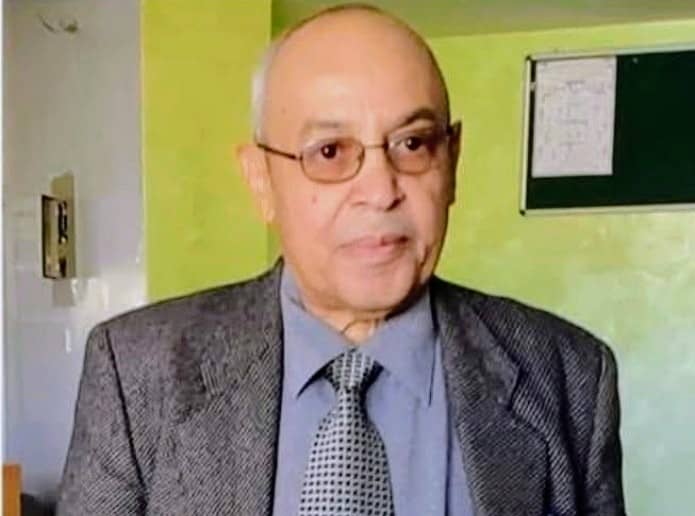
I have always been drawn to moments when a simple passion for learning transforms into a life rich in knowledge and generosity. This is precisely what I discovered in the journey of Professor Abdelrahman Al-Dirbiji.
From his early years in high school, he was never content with merely attending English classes. He read texts with great care, pausing at every sentence to reflect on its meaning, striving to understand what lay beyond the words rather than settling for correct pronunciation alone.
This habit of deep attention and sincere effort marked the beginning of a long journey—one in which texts naturally became an integral part of his daily life and thought.
His academic path began in Sudan, where he completed his secondary education entirely in English, studying all subjects except Arabic and Islamic Studies.
He was never a passive learner. Alongside his studies, he actively participated in language-related activities, becoming a dynamic member of the English Language Club and later serving as editor-in-chief of its monthly magazine.
In 1973, he enrolled in the English Department at the Faculty of Arts, University of Islamic Omdurman, graduating with honors in June 1977. His university years were marked by vibrant extracurricular involvement that enriched his academic experience and strengthened his social skills.
After returning to Yemen, he was appointed as a teaching assistant in the English Department at Sana’a University. In August 1978, he chose to pursue postgraduate studies abroad and enrolled at Portland State University in Oregon, USA.
There, he devoted himself fully to his studies and earned a Master’s degree in English Language and Literature in May 1980, with a GPA exceeding 3.5. Alongside his studies, he taught English to non-native speakers, gaining valuable early teaching experience.
In August 1980, he began his doctoral studies in Teaching English as a Second Language. During this period, he studied the works of renowned writers such as Mark Twain, Ernest Hemingway, and William Faulkner.
He also worked as a teaching assistant in the Curriculum and Teaching Methods Department, further refining his pedagogical expertise.
In May 1983, he earned his Ph.D. from Kansas State University and returned to Yemen, where he joined the Department of English Language and Literature as an Assistant Professor.
His academic career progressed steadily. He was promoted to Associate Professor in 1993 and later attained the rank of Full Professor in 1997.
Beyond teaching and research, his work extended into translation for both local and international institutions. He engaged in written and simultaneous interpretation at conferences and translated important official documents, including the Constitution of the Republic of Yemen.
Through this work, his academic pursuits intersected with his cultural and national responsibilities.
His professional experience also extended beyond Yemen. Between 1987 and 1988, he served as a Fulbright Visiting Professor in the Linguistics Department at the University of South Carolina, Columbia.
He later chaired the Master’s Program in Translation at King Saud University from 1988 to 1991, enriching his career with both academic leadership and practical experience.
During the 1995–1996 academic year, he moved to the United Kingdom as a Visiting Professor at the Manchester Institute of Science and Technology, where he worked under the supervision of Professor Mona Baker, a leading scholar in Translation Studies.
In the summer of 1997, he served as a Visiting Professor in the Translation Program at the University of East Anglia, supported by the British Council in Yemen.
He later became a Research Fellow at the Institute of Oriental Studies and Translation in Leipzig, following his fellowship at the Salzburg Global Seminar in Austria in the summer of 1998.
These transitions between universities and research centers broadened his intellectual horizons and provided him with a comprehensive vision of education and translation, connecting academic knowledge with an ever-evolving cultural reality.
Alongside his academic endeavors, Professor Al-Dirbiji remains active on his Facebook page, where he writes, translates various texts, and shares reflections drawn from his long experience in language and translation.
I find great value in his posts and translations, as they clearly convey his belief that translation is not merely a linguistic skill but a powerful tool for understanding and bringing cultures closer together.
To gain insight into his translation approach, one may examine selected texts he has translated, which reflect his deep engagement with meaning and context.
Alliances driven by expediency rather than ethics are ephemeral in nature and destined for failure.
كل التحالفات القائمة على مصالح آنية بدلًا عن قيم أخلاقية ستكون حتمًا قصيرة الأجل، ومآلاتها الفشل.
———————————————-
Mahmoud Darwish wrote:
أنت بعيد فأنساك، ولا أنت قريب فألقاك، ولا أنت لي فيطمئن قلبي، ولا أنا محروم منك لأنساك. أنت في منتصف كل شيء.
You are not far enough for me to consign your memory to oblivion, nor close enough for me to seek reunion. You are not mine, so my heart finds no peace, yet you are not entirely beyond my reach to allow me to forget you. You remain forever halfway through my life.
———————————————-
From the Holy Qur’an:
“(فأصبر صبرًا جميلًا. إنهم يرونه بعيدًا، ونراه قريبًا.)” – سورة الحاقة، الآيات 5/6/7
The Prophet Muhammad said:
Bear patiently with the hurtful speech of disbelievers and their denial of the Day of Reckoning. Though they believe it to be distant, it will surely overtake them.
———————————————-
The opposite of love is not hate, but indifference.
لم تكن الكراهية نقيض الحب، بل إن نقيض الحب هو اللامبالاة.
These examples reflect his linguistic sensitivity and his ability to listen attentively to a text before rendering it into another language. He prioritizes meaning and tone, striving to convey the spirit of the original rather than its surface form.
Professor Al-Dirbiji’s journey stands as a powerful model of enduring passion and unwavering commitment. Despite the immense challenges Yemen has faced, he has remained steadfast in his academic path, holding firmly to language and knowledge, and continuing his work with quiet perseverance.