

Reading Khaled Al Yousef’s Novels: The Saudi Novel and Najdi Memory
Yemenat
Prof. Dr. Hessa Bint Zaid Al Mufareh
Talking about Najdi memory in the novels of a writer from Najd may seem obvious. A writer is shaped by his environment, drawing from it his places, characters, language, and experiences, then reshaping them and recreating what his memory has preserved from its details.
For this reason, the question of why Najd appears in Khaled Al Yousef’s novels may not, in itself, lead to much in the way of critical inquiry. The presence of place and everything connected to it is expected.
The question becomes more important, however, when we shift our focus from the presence of Najd to the way it is transformed into narrative memory: What does the narrative choose to preserve from it? Who is given the right to remember it and represent it? And what does it bring back from people’s lives that may not have found a place in the official historical record? Places do not remain simply because they exist on maps. They remain because someone remembers them, carries their stories, and tells them again. Perhaps this is, in the end, one of the functions of the novel: to give a place another life in memory.
From this perspective, this reading does not treat Najd simply as a set of local signs that can easily be counted in the text. It is not enough to find the mud house, traditional Najdi food, the dialect, place names, or customs and traditions to conclude that a novel has brought the Najdi environment back to life. What matters more is the role these elements play within the act of remembering.
Reading Al Yousef’s novels shows that Najdi memory does not settle into a single form. It is not always carried by the people we might expect, nor does it remain within the borders of Najd itself.
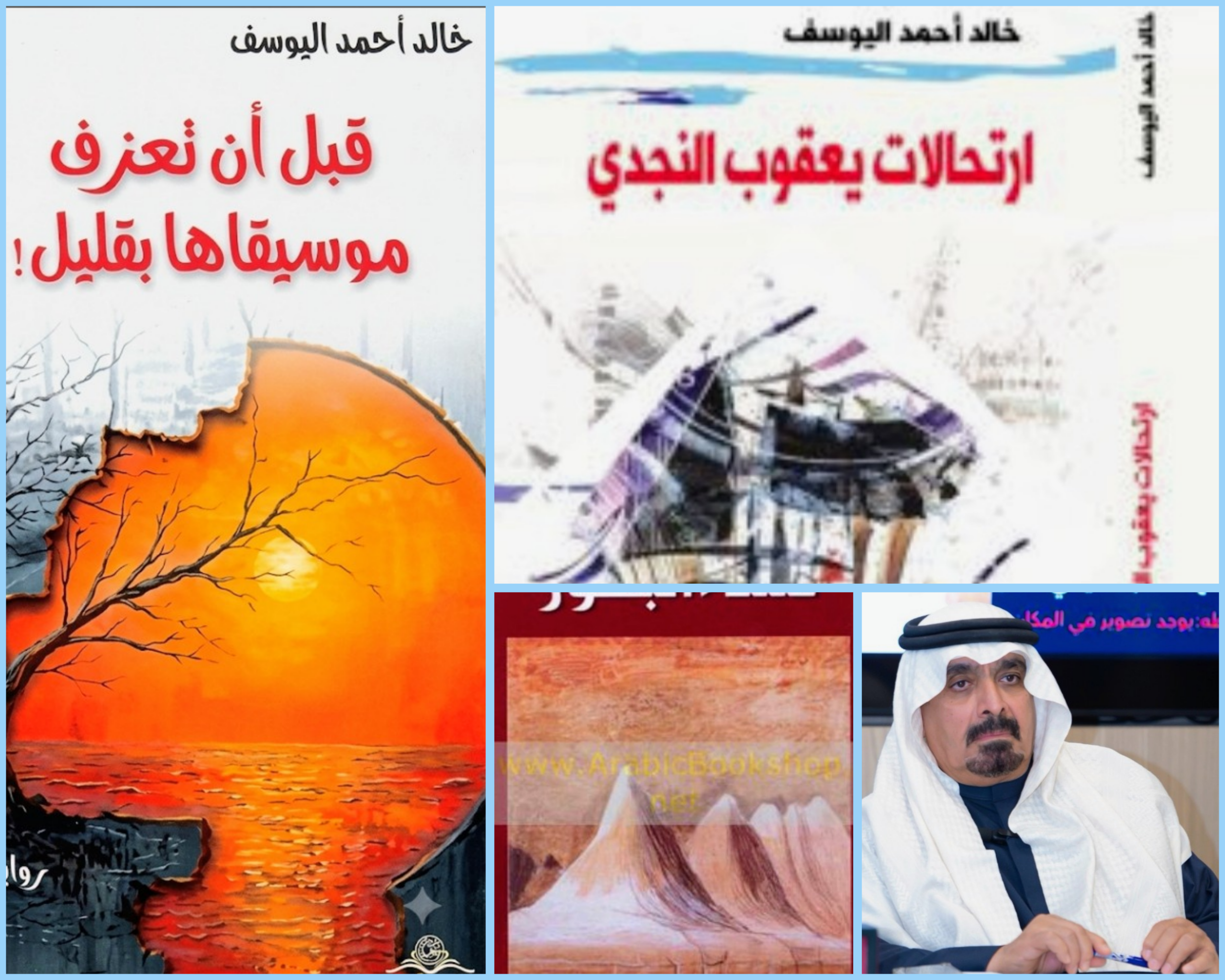
From here, this reading focuses on three novels: (Women of Incense), (The Journeys of Jacob Al Najdi), and (Shortly Before Its Music Begins). The aim is not to trace the presence of Najd throughout Al Yousef’s novels, but to look at three different ways in which the narrative works to create its memory
Accordingly, the question this reading begins with is not: Where do we find Najd in Khaled Al Yousef’s novels? Rather, which Najd does the narrative remember? How does it remember it? And who carries its memory? These questions open the way to looking at the different ways in which the narrative makes what is at risk of being forgotten possible to remember.
This reading does not necessarily treat these novels as historical novels, even though they bring back different periods, events, and changes from Najd’s past. Recalling history is not the same as working with memory. History, in one of its forms, seeks to reconstruct what happened, while memory is concerned with how the past remains in the minds of individuals and communities, and with what is chosen to be preserved or left to be forgotten. For this reason, the reading is less concerned with how much of Najd’s history Al Yousef’s novels have documented than with how the narrative has turned some of its places, characters, practices, and forms of art into carriers of memory.
This does not mean separating history from memory. The two often overlap, but the point of view is different. What matters here is not the past simply because it happened, but the past as it is remembered, passed on, and reshaped through narrative.
Nor does this reading treat memory as another word for heritage. Heritage refers to the practices, symbols, and knowledge passed down within a community. Memory, as it is understood here, is connected to the way the narrative brings that inherited material back, selects certain elements from it, and gives them new meanings.
Women of Incense: The Memory History Does Not Write
Earlier readings of the novel have drawn attention to the central role of (Al-Muqaybira Market), as well as the agency of women and the variety of its characters. However, the novel’s return to Al-Muqaybira can also be read from the perspective of memory, as something that goes beyond representing a place or highlighting the position and strength of women.
The market becomes an archive of everyday life, which usually remains outside written history. Najd, including Riyadh, is not brought back in the way a historian reconstructs a city that has passed. Instead, the novel brings back what we might call the lived memory of the place.
The French historian Pierre Nora distinguishes between history as a reconstruction of the past and memory as a living experience carried by communities. Memory lives in the minds of living communities and continues to change. It is connected to feelings and a sense of belonging, while also being open to change. It is spontaneous and does not need evidence to prove its existence. Nora also points to the importance of places of memory, which represent symbols that modern societies turn to in order to preserve what remains of their collective memory after spontaneous remembering has given way to written history (Saeed Hadef, “History and Memory: Overlap and Difference,” Al-Watan, Monday, 4 Rabi’ al-Thani 1446, October 7, 2024).
From this perspective, Al-Muqaybira Market does not seem to be simply an old place brought back by the novel. It becomes a place of memory in the sense that the experiences of an entire community come together within it. Here, the subtitle used in this reading, “The Memory History Does Not Write,” is supported by a critical concept rather than being simply a metaphor.
The German cultural historian Jan Assmann also distinguishes between communicative memory and cultural memory. The first lives through everyday, informal communication and does not necessarily depend on institutions, specialists, or fixed documents. The second is connected to more established and organized ways of preserving and passing on the past (Hassan Asweik, “Cultural Memory,” Al-Mawja Al-Thaqafiya: Thought and Criticism, January 16, 2016). Women of Incense comes close to what Assmann calls communicative memory, the kind of memory that lives through everyday communication and informal practices. When the narrative brings this memory back, it moves part of it from the fragility of everyday memory into the lasting form of the literary text.
If memory is usually built around major events, public figures, and changes that find their way into history books, Al Yousef takes a different approach to the memory of Najd in this novel. He turns to what lies outside the circle of major events, to everyday life that usually passes without leaving many documents behind. He makes Al-Muqaybira Market and its women a space for recalling part of the memory of old Riyadh, not as it appears in official records, but as it was lived by women who worked, sold things, treated illnesses, exchanged knowledge, and built relationships within the market and beyond it.
For this reason, the many details the novel presents about henna, hair braiding, myrrh, asafoetida, healing mixtures, sewing, herbal remedies, cooking, marriage arrangements, and traditional healing do not simply seem to be an attempt to decorate the text with words that belong to the memory of the place.
They bring back everyday knowledge that women carried with them: knowledge of the body and beauty, treatment and food, clothing and marriage, and social relationships. In this way, the market becomes something like a living archive, one preserved not by documents, but by practice, stories, and the memory of women in particular.
Maryam Al-Warqa stands at the center of this world as its most striking female character. She comes from the Najdi desert and remains closely attached to her roots. Within Al-Muqaybira, however, she becomes a woman with real authority. Her authority does not come from an official position, but from her place within the community and her ability to manage and organize the market. Here, the novel brings back a form of community organization that existed before the expansion of modern institutions, while also returning to memory the names of people who would not normally become protagonists of written history.
Yet Al-Muqaybira is not a closed Najdi space built around a single image of identity, as one might expect. It brings together Bedouin and urban women, as well as women from different social backgrounds. Outsiders such as Saeed and Shihab, the two Yemenis, also become part of its fabric. The market can therefore be seen as a small reflection of the city’s society, with all its diversity and interaction. The Najdi memory the novel brings back is not a memory of purity and isolation, but a memory of a life shaped by meeting and exchange.
The idea becomes clearer when the novel places the world of women alongside that of men. It shows the men occupied with war, sitting in cafés and following the news, while war remains largely absent from the lives of women, many of whom are confined to the home and Al-Muqaybira Market. This does not mean that women were outside history. Rather, they were living another kind of history: the history of work, marriage, childbirth, treatment, illness, buying and selling, and everyday relationships, as mentioned earlier.
This is where the function of memory in Women of Incense becomes especially clear. The novel does not compete with history in recording its major events. Instead, it turns to what history leaves behind, preserving the memory of everyday life and making the women of Al-Muqaybira, with their professions, knowledge, relationships, and nicknames, carriers of the social memory of a city that continues to change.
The value of these details, therefore, does not lie simply in their age or traditional character, but in the fact that they are remnants of an entire way of life that may disappear as the place and its people change, leaving only what narrative is able to bring back.
The Journeys of Jacob Al Najdi: Memory and the Identity of the Traveler
Earlier critical readings have connected the novel with changes in space, recollection, and history. Yet the word “Najdi” in the title allows us to go much further. The journey becomes a way of looking at what happens to the identity of a place when a person carries it from one place to another. If the journey has been read as a transformation in space and character, reading the novel from the perspective of memory reveals another kind of transformation: the place that Jacob Al Najdi carries with him does not remain the same, just as the places he travels to also leave their mark on him.
The French sociologist Maurice Halbwachs argues that individual memory does not work in isolation. It is formed within social frameworks such as the family, religion, and social class. Memory is selective by nature, but it differs from history, which is a critical and objective reconstruction of the past after living memory has been interrupted (The Social Frameworks of Memory, translated by Nahed Abdulhamid Ibrahim, National Center for Translation, 2026). The continuity of communicative memory, therefore, is connected to the continuity of social ties and frameworks.
This understanding of memory may be useful in reading the memory of The Journeys of Jacob Al Najdi. Jacob does not remember his homeland, Al-Zulaifat, on his own. The community shares in the act of remembering and sometimes imposes it on him. His companions bring the place back before him, while the people of Al-Zulaifat reshape it beyond its original boundaries. In this way, Jacob’s personal refusal to return is unable to erase the memory carried by the community.
If (Women of Incense) builds the memory of Najd from within the place, The Journeys of Jacob Al Najdi builds this memory both from within and from outside it. The novel begins with Jacob already away from his homeland, then returns to his past, so that the journey through space is always accompanied by a reverse journey through time. Jacob moves farther away, while memory takes him back to the places he left behind. The journeys, therefore, do not appear simply as geographical movements, but as a continuous test of the relationship between a person and the place he came from.
This relationship begins with Al-Zulaifat, Jacob’s first Najdi homeland, which he left with his companions, or foster brothers, fleeing famine, fear of death, and perhaps strict religious attitudes. The novel does not bring the place back simply as an abandoned homeland. Instead, it brings back an entire way of life, making memory a storehouse for the details of everyday life from which the place formed its identity. Yet Jacob’s relationship with this homeland is not based on pure nostalgia. While the others decide to return and apologize for the sudden flight from it, he refuses to go back and seems resentful toward it.
This Najdi place carries conflicting feelings, bringing together love and hatred, sadness and joy. Memory, therefore, does not offer an idealized image of the old place. It is the homeland of the red Nufud, the valleys after the rain, the palm trees, and the pools, but it is also the homeland of famine, strictness, and experiences of loss that pushed its people to leave. Remembering thus becomes capable of holding beauty and pain at the same time.
The journey expands from Al-Zulaifat to Al-Arid, and within Najd the character begins to discover differences between places and patterns of settlement, from narrow alleys and closely built houses to differences between neighborhoods and markets. Among them is Al-Muqaybira Market, which appears here from a different perspective than in Women of Incense. The journey reveals that Najd is not a single, uniform image. Differences in ways of life allow the Najdi himself to discover the diversity of Najd from within.
The deeper meaning of the journey, however, appears when it moves beyond Najd to Kuwait, Al-Zubair, Basra, the Levant, and other places that became destinations for Najdi travelers. Whenever Jacob thinks he has moved farther away from his homeland, he finds traces of it in the new place. In Kuwait, he is surprised by the large number of people from his homeland, to the point that he imagines he has returned to it. In Al-Zubair, he sees features of Al-Zulaifat, Sudair, and other places, until the novel presents it as a space where different parts of Najd come together outside its geographical boundaries.
This gives a deeper meaning to a statement such as, “No land does my feet step on without finding in it a son of Al-Zulaifat.” Al-Zulaifat is no longer simply a fixed town that Jacob left behind.
Through its emigrants, it has become a place that is carried with them and spreads wherever they go. The dialect, facial features, the community’s homes, and some of its customs become ways through which memory can recreate the homeland far from its own land. The statement, therefore, is more than a description of migration. It is a testimony to the social framework of memory.
The irony is that Jacob, who refuses to return to Al-Zulaifat, cannot escape it. His companions remind him of it, he is affected by the way they describe it, and the scenes along the road awaken its name within him. It is as if the novel creates a distance between returning to a place in reality and returning to it through memory. Jacob can refuse the first, but he cannot prevent the second. His hatred of the place, if that is how it appears, does not mean that he has forgotten it. Rather, it reveals how deeply it remains present within him. Memory here is not the same as nostalgia. It can also be a form of resistance, bringing back what the character is trying to push away.
Yet one of the novel’s most striking ironies lies between its title and the name given to Jacob after he settles in Kuwait and then leaves it. The novel calls him “Al Najdi,” but when he returns to Najd, he becomes “Jacob Al Kuwaiti.” Between these two names lies the whole experience of the journey. A person leaves carrying the name of his homeland, then the places where he lives leave their own names on him. The first place is no longer enough to define him, but the new place cannot erase his earlier memory either. Jacob’s identity thus becomes an accumulation shaped by the places he has lived in.
The Najdi who carried Najd outside its borders returns to it carrying the outside world with him. The novel therefore does not simply ask where Jacob belongs. It also shows that the journey itself changes the meaning of belonging.
Shortly Before Its Music Begins: Artistic Memory, from the Margins to Recognition
If (Women of Incense) brings back the memory of everyday life, and The Journeys of Jacob Al Najdi examines memory through travel, this novel moves the question into a different field: art and music. Here, Najd does not appear only in homes, markets, and roads. It also appears through an artistic form carried by groups and individuals, and which for a long time remained under the weight of a socially cautious attitude toward singing and those who performed it.
Jan Assmann offers an idea that can be useful here. For him, cultural memory does not preserve itself through ideas alone. It also needs forms, practices, and means through which it can be stored and repeated (Al-Hassan Asweik, “Cultural Memory,” previous reference). This corresponds closely to art in this novel. It is a form of memory that is performed, requiring bodies, voices, rhythm, a community, a place, and repetition.
If earlier readings of the novel have viewed it as a narrative of musical change and the movement toward celebrating art, the perspective of memory reveals another irony: Najdi art is present in the novel even when its performance is absent. The postponed and then cancelled Najdi night does not create a narrative void. Instead, it makes artistic memory present through its absence and through the expectation of its return.
The novel centers on Mubarak Bin Hadab, a music enthusiast and admirer of the world-famous musician Yanni Chryssomallis, who dreams of meeting him and introducing him to the musical heritage of his country. From the very beginning, the novel raises an interesting issue. Mubarak, whose dark skin the narrative describes as the result of a mixture of different ethnic backgrounds, becomes one of the most prominent carriers of folk music in Najd. This becomes especially significant when the text recalls a social attitude that associated certain forms of singing with particular groups. This is clear in the father’s refusal to describe this music as the music of the slaves of the Dawasir, as well as his rejection of singing itself, which he sees as a path that brings no benefit, cuts off a person’s livelihood, and wastes his life.
The novel does not present this attitude as an isolated personal opinion. Instead, it places it within a broader social memory of the relationship between art, acceptance, and rejection. Despite his father’s objection, Mubarak joins the Samri groups that travel across Najd. The house of Umm Khlawi in Manfuhah also appears as a place where lovers of singing and folk art gather. Here, the novel preserves the memory of art in its informal spaces, before it becomes part of a more organized and recognized artistic scene.
Mubarak’s move into the military takes on a particular meaning in this context. He joins the military in response to his father’s wishes, but his love of music and his skill at playing lead his commander to send him, along with a number of his colleagues, to a music institute. It is as if the path his father tried to close returns to Mubarak from within the institution itself. Art thus moves from a hobby and a social practice surrounded by reservations to training, professionalism, and institutional recognition.
Yet Najdi artistic memory does not remain confined to Najd. In Cairo, Mubarak meets his favorite musician, who expresses his enthusiasm for visiting Saudi Arabia and learning about its arts. The group later hosts the musician in a setting that takes on a Najdi character through its majlis, hospitality, and food, while also opening outward to other local traditions.
The novel reaches the height of this idea when friends from different regions of Saudi Arabia agree that each of them will present the art of his region on a separate night: the Hijaz, the north, Asir and Jazan, and Najd. The Najdi night is planned as the final one, but circumstances arise that lead Yanni to decide to leave before it takes place. Mubarak then reproaches him, asking, in the spirit of his protest, how he could leave before enjoying the Najdi night.
Here, the night that never takes place becomes one of the novel’s most meaningful ironies. The other regional arts appear through their performances, while Najdi artistic memory remains postponed. Yet this absence does not erase its presence. The Najdi night is present precisely through its absence. This absence becomes even more significant because the carrier of this artistic memory, Mubarak, is not presented as a simple model of a Najdi man connected to a pure local lineage. As mentioned earlier, the narrative points to the mixture of different ethnic backgrounds in his blood and skin. We can therefore read the choice of this character beyond direct ethnic classification. Cultural memory does not necessarily have to be carried by someone who represents a place through lineage. It can be carried by someone who practices its culture, preserves its arts, and passes them on to others. Mubarak belongs to the art he carries as much as that art belongs to the geography in which it was born.
In this way, Khaled Al Yousef’s novels do not bring back Najd as a complete past preserved in a single repository. Memory is spread across the market, the road, the home, the voice, the body, and the community. What the novel gives these elements is not simply presence, but the ability to become carriers of memory threatened with disappearance. In Women of Incense, the narrative saves from oblivion the knowledge of everyday life that does not usually enter official history. In The Journeys of Jacob Al Najdi, it frees the place from its geographical boundaries, turning it into a memory carried by the community and by the traveler himself. And in Shortly Before Its Music Begins, art is not simply a medium through which memory continues through performance. It is present even when performance itself becomes impossible. Together, the three novels raise a set of connected questions: Who carries the memory of Najd? Through what medium can it be carried? And what might have been forgotten if the narrative had not preserved it?
The three novels also show that Najdi memory in Al Yousef’s work becomes especially active at the edges of loss: when a way of life is about to disappear, when a person leaves his place, or when art moves from one social space to another. It is as if the act of storytelling begins when forgetting becomes possible.
Translated from the original Arabic article published in Al-Yamamah magazine.
Translatied by Mohammed Al-Mekhlafi