

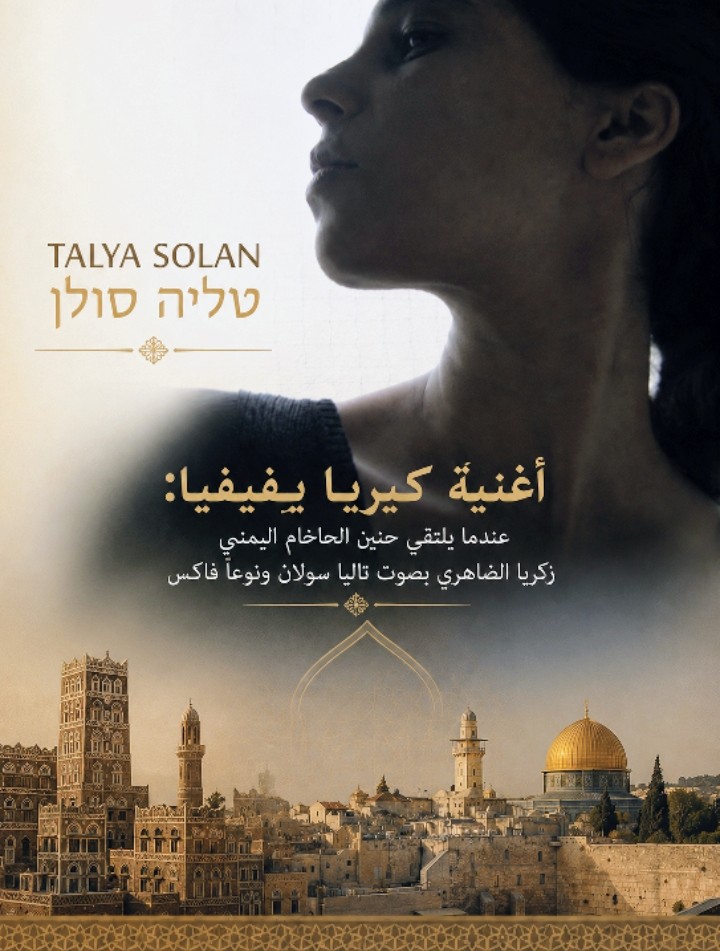
The Hebrew Yemeni Song “Kiryah Yefefiyah”: The Longing of Rabbi Zechariah al-Dhahiri and the Voice of Talia Solan
Yemenat
Hamid Oqabi
Some works of art transcend the boundaries of time and place, evolving from mere texts or songs into bridges that connect generations and cultures. Among these enduring works is the poem Kiryah Yefefiyah (קריה יפהפיה), meaning The Beautiful City, written by the renowned Yemeni Jewish poet and traveler Rabbi Zechariah al-Dhahiri in the sixteenth century. More than four centuries after its composition, the poem remains alive in musical memory, rediscovered by each generation and enriched with new meanings while preserving its original s
The poem has found renewed life through the performance of singer Talia Solan, accompanied by percussionist Noa Vax. In this artistic encounter, we hear far more than an old heritage text. We witness a dialogue between past and present, between Yemen, Jerusalem, and the wider world, and between a poet who lived in the sixteenth century and two contemporary artists committed to rediscovering cultural heritage and sharing it with new audiences.
Rabbi Zechariah al-Dhahiri occupies a unique place in the history of Yemeni Hebrew literature. He was a traveler, thinker, and scholar whose broad intellectual horizons enabled him to create a remarkable literary legacy. Born in Yemen during the sixteenth century, he lived in a period marked by vibrant cultural and religious activity. He possessed a profound command of Hebrew language and literature and was influenced by the traditions of Andalusian Hebrew poetry as well as by the works of earlier Jewish poets. Yet his achievement went beyond influence alone. He successfully reimagined those traditions within distinctly Yemeni literary forms.
Modern scholarship indicates that al-Dhahiri left behind a substantial body of work, including his celebrated book Sefer Ha Musar as well as hundreds of poems, hymns, and religious compositions. Specialists in Yemeni Jewish literature often regard him as second only to the great poet Shalom Shabazi in stature and influence.
His significance also lies in the fact that he was among the earliest Yemeni Jewish travelers to record his observations and experiences beyond Yemen. He viewed the world through the eyes of both a poet and an intellectual, and his writings are therefore rich in cultural and human detail, infused with reflection, curiosity, and a spirit of inquiry.
Kiryah Yefefiyah is widely regarded as one of the most beautiful poetic expressions of longing for Jerusalem in Yemeni Jewish heritage. In the poem, Jerusalem is not merely a sacred city. It becomes a powerful symbol of belonging, memory, and the search for roots. Al-Dhahiri addresses the city as though it were a living presence, endowed with a unique spirit and worthy of devotion.
He opens the poem with the lines:
“Beautiful city, delight of all cities,
Faithful city to your kings and princes.”
From the very beginning, Jerusalem is presented as a place of exceptional beauty and splendor. It is not simply one city among many. It is the city that surpasses all others and gives meaning to everything within and around it.
The poet then turns inward, expressing a deeply personal yearning:
“For you my soul has been consumed with longing,
To dwell within your courtyards.”
At this moment, the poem moves beyond description into emotional confession. Jerusalem is not only an object of admiration. It is a profound desire that inhabits the poet’s heart and imagination.
The enduring power of Kiryah Yefefiyah lies in its ability to transform intense longing into poetic images that are both simple and profound. Among its most memorable lines are:
“Who will grant me wings to fly like a dove,
That I may kiss your stones and embrace your dust.”
At first glance, the image appears straightforward, yet it carries multiple layers of meaning. The dove evokes peace, freedom, and return. Flight is not merely a dream of geographical movement but a yearning to overcome the barriers that separate a person from the place they love.
Even the stones and dust of Jerusalem become worthy of affection and reverence. Such imagery reveals a deep attachment to place and a distinctive sense of sacredness, where the smallest details become inseparable from identity and memory.
No brief reading can fully encompass the richness of this text. The poem extends beyond personal longing and embraces a collective experience of exile and displacement. Al-Dhahiri speaks not only for himself but for a community that feels distant from its spiritual center and yearns for a path back to it.
Kiryah Yefefiyah stands as an important example of the religious poetry that flourished among Yemen’s Jewish communities. Preserved through oral performance and communal chanting, such works played a central role in cultural life. They were more than devotional texts; they became vessels of memory, history, and identity.
Across generations, the poem remained alive through performance and transmission. Eventually, it entered the world of contemporary music and became one of the most widely performed and recorded works of Yemeni Jewish heritage.
Listening to Talia Solan’s interpretation of the poem, one immediately recognizes an artist who approaches heritage not as a fixed artifact but as a living source of discovery. She engages with traditional texts with both affection and creativity, treating each one as an opportunity to uncover new meanings while honoring its origins.
Solan is widely known for her dedication to the musical traditions of Eastern Jewish communities, particularly Yemeni and Sephardic heritage. Over many years, she has devoted herself to collecting historical texts, studying traditional melodies, and presenting them within contemporary artistic frameworks. Her work as the leader of the ensemble Yamma has made her one of the most prominent figures engaged in the revival of these musical traditions.
What distinguishes Solan is her refusal to simply reproduce old songs as museum pieces. Instead, she seeks to reveal the emotional energy that continues to reside within them and to communicate that energy to contemporary audiences.
This commitment has helped establish her as one of the notable voices in today’s global music scene. Her passion for preserving and revitalizing Yemeni Jewish heritage has encouraged countless listeners to explore Yemeni music with genuine appreciation and curiosity.
The ensemble Yamma has become an important artistic platform through which these traditions reach audiences across Europe and beyond. Under Solan’s leadership, the group has successfully combined Yemeni, Sephardic, Middle Eastern, and Mediterranean musical influences while maintaining deep respect for the cultural origins of the works it performs.
Through concerts, recordings, and international tours, Yamma has introduced audiences around the world to songs and poems that for many years remained largely confined to local communities. In doing so, the group has presented Yemeni Jewish heritage not as the possession of a single community but as part of a broader human cultural legacy.
Although the focus of this article is primarily on Talia Solan’s voice, a full understanding of this performance would be incomplete without acknowledging the contribution of percussionist Noa Vax. Vax is an innovative musician who believes that song emerges from a deeper spiritual source, and for this reason she becomes an essential partner in shaping the sonic world of the piece.
She works with hand percussion, frame drums, and various Middle Eastern rhythmic traditions, treating rhythm not as background accompaniment but as a language in its own right. In Kiryah Yefefiyah, her approach is marked by restraint and sensitivity. Rather than introducing loud or dominant rhythms, she creates a calm and reflective sonic space that aligns with the emotional tone of the poem.
At moments, subtle influences drawn from Indian and global musical traditions appear in her playing, yet they never overwhelm the core Yemeni character of the piece. Instead, they function like a gentle current that expands the emotional horizon of the music without disturbing its roots.
In this sense, rhythm becomes an integral part of the narrative itself rather than a decorative layer added to it.
A close reading of the performance reveals a shared artistic philosophy between Talia Solan and Noa Vax, defined by restraint, clarity, and a deliberate avoidance of excess or ornamentation. The voice enters calm and saturated with longing, while the percussion moves with precision and lightness, ensuring that the words remain at the center of the experience.
The work does not attempt to impose a modern reinterpretation onto the text. Instead, it allows the poem to speak in its own voice while placing it within a contemporary soundscape that speaks naturally to today’s listener.
What emerges is an artistic experience that respects the past without turning it into a fixed replica, and engages the present without breaking its connection to historical roots.
The song reflects a long journey that began centuries ago in Yemen and moved across Yemen, Jerusalem, and the wider world. It was written by a Yemeni Jewish poet who lived through travel, exile, and searching. It was preserved through generations, carried within collective memory across generations, and later transported by migration to Israel. Over time, it reemerged on international stages through artists such as Talia Solan and Noa Vax.
In this way, Kiryah Yefefiyah stands as a living example of art’s ability to transcend geographical, political, and temporal boundaries.
A critical commentary on the song is available at the following link:
https://youtu.be/uQzzaGIW5MA?si=Oh_4AOuguHaCKi0b
In conclusion, the significance of Kiryah Yefefiyah lies in its convergence of three creative layers. The first is the poetic text of Rabbi Zechariah al-Dhahiri, one of the most important literary figures in the history of Yemenite Jewry. The second is the musical and oral tradition that preserved the poem across centuries. The third is the contemporary artistic interpretation offered by Talia Solan and Noa Vax.
In the meeting of these layers, longing and memory are transformed into sound, and heritage becomes a living, evolving experience. Kiryah Yefefiyah thus emerges as a work deeply rooted in humanity and continuously open to the future, carrying its journey forward through both time and emotion.