

Poet Dr. Mohammed Al-Shameiri: Reaching Does Not Require Two Feet
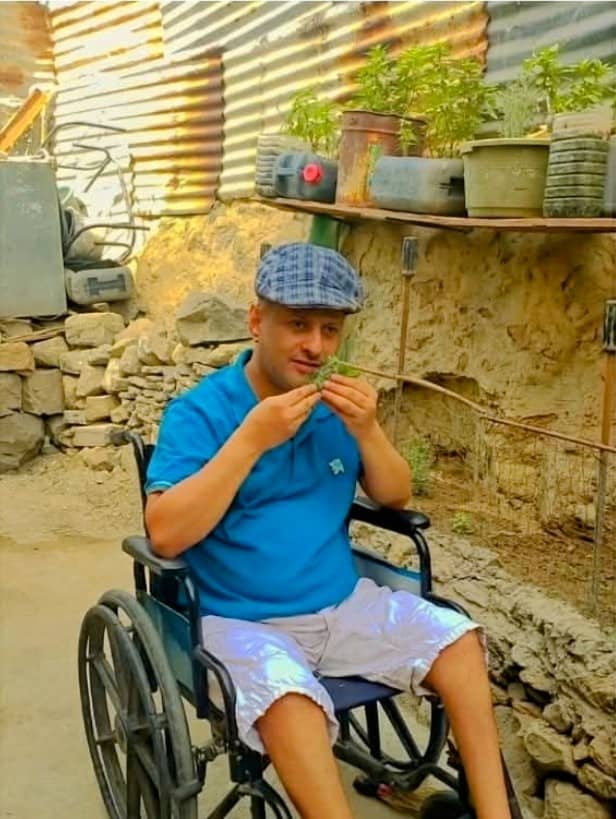
Yemenat
Interview by: Mohammed Al-Mekhlafi
In a delightful session, the Yemeni poet, writer, and doctor Mohammed Al-Shameri revealed a life journey that began in a countryside childhood filled with longing and adventure, passed through a painful accident that altered the course of his destiny, and culminated in a disability that ignited within him a flame of optimism and vitality—transforming into poetry and prose brimming with honesty and courage.
Al-Shameri said:
“I was born in the village of Al-Hoqueil—literally a diminutive of field. It was a village shaped by human hands. I mean that quite literally: the land was not fertile. Our forefathers carved their fields from stone and clay, bordered them with rocks hauled from the heart of the mountains. The result was small, stony plots where crops struggled fiercely to break through the earth. Perhaps that is why, to justify my short stature, I often likened myself to those besieged plants.
And yet I lived a pampered, happy childhood—perhaps because I was the first boy after three sisters. I could swear I understood their joy at my birth, and I exploited it to the fullest. Even as more boys followed until we numbered ten, I clung to my early privileges. I never carried a jug of water, nor a bundle of firewood or crops. My world was football, academic success, and selling chocolates and chewing gum at women’s weddings.
Few would believe that my most vivid childhood memory is the moment I tried to fly from the rooftop of a three-story house at the age of four—or the way I used to smear my mother’s hair cream into my curls, trying to make them smoother, just to impress my Egyptian classmate in third grade.”
On his beginnings with poetry, he said:
“From my earliest years I read the Qur’an and memorized most of it. I studied grammar, jurisprudential and ethical treatises, enchanted by their rhyme and rhythm, many of which I can still recite today. At school I was drawn to the microphone of the morning assembly, to memorizing and performing poetry. I remember my first great public festival—back in fourth grade—when I recited a poem by Al-Zubayri. From then until the end of secondary school I was always on stage.
At university, I wrote my first poem. Later, life’s noise and the weight of work distracted me. Poetry and art only returned to me through fate, when a car accident in 2007 tried to steal my life. I have read across all eras and poets, and every text, every book, has left its trace upon my words in one way or another. It is no exaggeration to say that my greatest drive has been the clinging to life, the refusal of death, and the need to reclaim my days from every moment once shadowed by prohibitive fatwas of fear.”
On studying pharmacy, he added:
“Pharmacy is a science inseparable from its artistic moment. Every formula, every compound, is a chemistry of interactions that mirrors the first spark of a poem. I never felt there was a gap between my profession and my poetry.”
On the accident that changed his life forever, he said:
“When death shook my hand in that accident and then walked away, I realized that I deserved nothing but life. That is what I wrote on the very same day. I did not lose consciousness, nor did Asalah stop singing ‘Only my heart is yours, my beloved, and my love.’ I clasped death by the hand—and carried it with me into the uproar of life.”
About the poem he wrote after the accident, he said:
Death, a gracious greeting
offered by salvation
to bodies that do not return the salute.
Death,
a solemn answer in eloquent tongue
to countless questions
we erred in asking.
Colloquial speech was our first ruse
to commit immortality.
The rules we planted
in the throat of love—
concrete girders tightening
the ribs of silence,
completing the muteness.
Death, the one who once shook my hand in an accident,
and then departed—
I hurled a single song in its face:
“Only my heart is yours, my beloved, and your love…
It did not betray me,
even when I forbade myself from love.”
I never prefer to gather songs into a single album.
How beautiful—
the rose cast alone, at the far edge of sight.
The wild grass defying
the laws of agricultural geometry.
Faith unchained
from the idea of reward,
and desire postponed.
Death is so available—
in books that escape
the prison of library shelves.
Death despises numbers.
One
Two
Three
Stop.
Allah, Allah, Allah—
how beautiful is cinema,
how ugly the directors!
On the lesson he drew from his experience with disability, he said:
“The very first gain I reaped from disability was the government post I had long been denied since graduation, for lack of opportunities. I received it immediately within the quota reserved for the disabled. But the greater lesson was this: reaching does not require two feet. I must confess here that my life did not change much afterward—perhaps because I had always been lazy, and remain so to this day.”
He adds:
“Many see disability as a prison. I do not deny that it can be so. Yet it may also open a wider horizon than the constraints of reality and the taboos of other people’s lives. I do not say this out of a claim to heroism, but simply because I love life. Even at fifty, I remain a child, refusing to grow old. So I live each moment as it is, sparing no effort in doing so. I am deeply convinced that brooding over disability and standing still before it will not change its truth in the least. And so, I live every inch of what is available—with all my madness.”
On his poetic experience, he says:
“I do not know whether I am truly a poet or not, but I am certain that I know how to express my moment without the weight of rules or governing theories. I do not plan, nor intend, nor do I like categorization or labels. I let the text take flight as I once tried to leap in childhood—except that now I no longer restrain it as my father once did, threatening me with a stone in his hand. What I write is an impulse, a reaction, an entanglement with life. Some call it chaotic, others call it childlike—mastering the classical tongue only to suddenly impose its rustic dialect. Certain critics dislike it, fearing for the tower of language to collapse into the local. But I, for my part, love every text—even the weakest among them.”
On the presence of women in his work, he says:
“I must recall what a friend remarked after reading my book ‘Winds in a Stubborn Scrap.’ He noticed that woman was present in every text, whether lyrical or otherwise. And he was right—for I am a man shaped by a woman.”
On his reading, he reflects:
“Every book I have read has left its trace—on my face and in my words. The first novel I ever read was in sixth grade, when an older man who could not read asked me to read Les Misérables by Victor Hugo aloud to him. To this day I remember the wonder I felt, a wonder for which I still have no explanation. As for poetry, though I have read nearly everyone, I always found in Abu Al-Qasim Al-Shabbi’s verse a liberation, an elegant simplicity, and an irresistible influence.”
On his writing rituals, he explains:
“I have never lived that moment of ‘inspiration’ I read about in the accounts of many poets. In my early days I even thought they came from another planet. I write whenever I want—whenever my emotions and interactions with life overflow. Every moment we live can be a text. And yet there are times when I cannot write at all, no matter how hard I try.”
On his participation in festivals and cultural events, he said:
“This question sums up my very existence. I cannot sit alone. I do not recall ever asking for a moment of solitude. I find life in sharing it with others. That is why I attended nearly all literary, artistic, and human-rights events. Unfortunately, recent economic circumstances have prevented me from doing so, so now I choose just one event per month. I explain it all by my love for life and for people—for every person I meet strengthens my presence and adds to me.”
On the cultural scene in Yemen today, he says:
“I do not believe there is a comprehensive, institutional cultural scene. What exists are cultural elites that have flourished at times and faded at others, depending on the political climate. Within these shifts, poets and writers have emerged whose marks extended beyond the local sphere. Today, however, the scene is built on individual initiatives and voices striving to create despite fear, hunger, and unemployment. Perhaps this explains the abundance of output—where quantity prevails and quality is scarce. Still, there are young pens that have managed to secure their place on the Arab and regional stage. And I remain always optimistic, so long as there are those who refuse to die creatively.”
On his upcoming projects, he said:
“In 2020 I published ‘Winds in a Stubborn Scrap’—a blend of very short stories and flashes of prose. Soon, a collection of texts will be published under the title ‘I Stole My Mother’s Flowers.’ I also have a novel, ‘Brown Bread,’ that still needs refinement, along with a collection of very short stories titled ‘A Star Fell into the Alley.’”
On his poetic and human message, he summarized:
“Writing now resembles the motion of inertia—it is neither driven by meaning nor does it lead anywhere. A motion unratified by fate. I try to believe, yet my stubborn nature does not acknowledge revelations that fall from above. As for my human message: never withhold a kind word from someone who deserves it.”
In conclusion, he said:
“Literature, art, creativity—whether a text, a painting, or a song—need not mirror the life of its creator. It may even be its opposite. Do not judge the creator, for the text itself is the true arena of critique.”
He then read another poem.
The distance between two shoulders
is farther than an impossible suspended
on the tablet of absence.
The sea asks me about the years of waves—
how I walked them,
while my loss never wore
the blue of longing?
Thanks to a laughter
that left no wrinkle
on the grain of grieving sand.
Thanks—as no tree deserves—
to the murmur of a trunk
stuffed with ancient shadow.
Thanks to the pillow the garden abandoned,
so my crippled madness
could sleep upon its memory.
Thanks to the echo
keeping vigil without a hat,
keeping vigil as the songs say,
and when dawn stammers
the rooster calls far away
in the heights of weeping.
Thanks to you, silence—
as you search the pouch of time
for the wool of mirrors,
for the winter of illusion,
for the warmth of poems,
and longing—
my double longing,
like a cunning agent
writing his autobiography,
smoking his retired pipe,
closing death’s service,
and drawing his spirit
onto paper.