

From Here I Began
Yemenat
Mohammed Al-Mekhlafi
After I left compulsory national defense service and returned to my village, I noticed the looks of astonishment and reproach in people’s eyes. They would constantly ask me, “Why did you leave the camp?”
I spent an entire week repeating the question to myself, thinking, analyzing, and reconsidering again and again. Then I made a decision: I would return to the military college, my assigned post, as the university would not open its doors to me until I had completed my military service.
I packed my simple belongings and gathered what remained of my modest salary, which at the time was four thousand riyals per month.
After al Maghrib prayer, I went to my sister Najat’s house on the outskirts of the village to bid her farewell. There, fate willed that I would meet Abdulbasit Mohammed Dabwan.
I greeted him and told him of my intention to return to the camp.
He smiled and said:
“Don’t go back.There is a better opportunity.”
I asked him in surprise:
“What is it?”
He said: “I met Ebrahim Ahmed Saleh from the neighboring village. He was then working as the office manager for the Director of Aden Security. I asked him to enroll you and my brother Majed in the Aden Security Administration, and he agreed. But he instructed me not to tell anyone about the matter.”
I was overjoyed. I praised Allah abundantly and thanked Abdulbasit, saying to myself:
“Finally,I will study at the university and achieve my dream.”
University studies were my utmost preoccupation, never leaving my thoughts. I often sat wondering: Who would help me? Both my parents had passed away, may Allah have mercy on them, and there was no longer anyone to stand by my side. But now, after this unexpected opportunity, I would work and study, and I would strive with all my might to reach what I had dreamed of.
The next day, I met Ebrahim. I greeted him and thanked him, and he informed me that he wanted to enroll a group of high school graduates, especially orphans who had no one to support them. I remembered my colleague Hisham Al-Ozli, with whom I had studied in the first year of high school at Salah Al-Din School in Al-Husain. He was an orphan.
I went to his village, Hamraj, on foot in the afternoon under the scorching summer sun. I traversed a distance of five kilometers, perhaps more, until I arrived. At the village entrance, I spotted him working with some of the village youth in quarrying stones. I greeted them.
Hisham was surprised to see me; he thought I had come to visit Mr. Mohammed Bajash, our mathematics teacher. He climbed down from the quarry, greeted me, welcomed me, and then asked why I had come to the village. I replied, “I came for you.”
He excused himself from the other young men and came with me to the edge of the village, where I told him the reason for my visit. He was overjoyed, thanked me, and then I asked him to give me some 4×6 photos to use for the registration paperwork.
He said he didn’t have any photos, but he had a copy that could be used for printing. He went and fetched it from his house, and in his excitement, he walked back with me all the way to my village, Kinda. We covered the same distance that had initially seemed long, but our laughter and conversation transformed it into a short, enjoyable journey.
There were six of us young men from different villages, and we waited for about two months for our registration procedures with Aden Security to be completed. During that period, I kept in touch with Ebrahim, who reassured me that everything was going well. during one of our conversations, he told me, “Praise Allah, you have all been registered. All that remains is to arrange for accommodation.”
I informed my friends and suggested that I contact Ebrahim to let him know I had a friend in Aden with whom we could stay until the accommodation was ready. They agreed with my idea.
The next day, I contacted Ebrahim and told him, and he welcomed the idea. I immediately contacted my friends, and we set a date for our travel.
I remember that two days before our departure, Majed and I went to the tailor’s shop near our village and had long shorts made that reached the knee, with zippered pockets to keep our money safe.
On the day of travel, I woke up early, had breakfast, bid my family farewell, and headed to Kinda junction, our meeting point. From there, we took a a truck to the city of Taiz, and then continued directly to Aden.
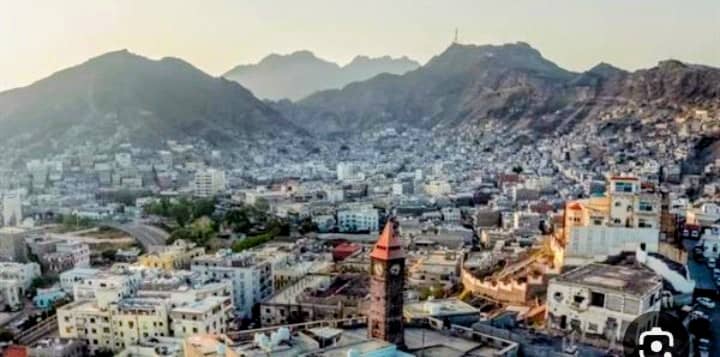
We reached Aden at twelve o’clock. The moment we stepped out of the Peugeot, we felt the intense heat and the blazing sun, as if it were about to consume us. Waiting for us there was my study friend, Abdulmalik Al-Qadhi, who took us to his workplace at an unfinished house in Al-Mansourah District. We spent that night on the rooftop. In the morning, I contacted Ebrahim, who asked us to come to Khormaksar.
We went straight there and waited for him in front of Ramzi Labs, opposite the Security Administration building. He asked me to enter alone. I went in, my eyes scanning every direction. He pointed, saying, “This is the Director’s office, and that is the secretariat.”
I sat in the hall for a short while, then a staff member came and offered me a cup of Nescafé. I was captivated by its taste; it was the first time in my life I had sipped this kind of coffee.
Ebrahim called me and took me to the accommodation designated for us inside the Security Administration building. Afterwards, I returned to my friends waiting outside and told them what I had seen inside. They looked at me in astonishment, but what surprised them most was my talk about the taste of the Nescafé.
At the end of the workday, we were permitted to enter the building. We distributed ourselves among the rooms and were provided with bedding. The next day, we were sent to work in the Operations Room of the Aden Security Directorate. We started working enthusiastically, and I remained in that department for about a month.
Some tourists would come to obtain permits to visit Aden, and I would speak with them in English. It happened one day, Abdullah Abu Shousah, the bodyguard to the Security Director, noticed me speaking with a tourist while he was in the operations room. He later spoke about me to the Security Director.
The next day, the Security Director summoned me to his office and said:
“I want you to work with me here in the office.Review the daily newspapers, identify security-related topics, respond to matters requiring a response, and also handle translation when needed.”
After that, he sent me to the Moral Guidance Department to learn the basics of journalism with a group of journalists. I stayed there for a short period but learned quickly, as I had been passionate about journalism since youth.
I started reading the “Yemen Times” newspaper in English back when I was in the first year of secondary school. My friend Fawaz Saeed Abdo was studying in Taiz city at the time and would return to the village every Thursday with a copy of the newspaper. I would devour its articles, translate them, and imagine myself as one of its writers. The person I most wished to emulate was Dr. Mohammed Al-Qadhi.
In 2001, I enrolled in the English Department at the College of Education, Aden University. I would wake up early in the morning and start my day by browsing about ten daily newspapers, including government, independent, and opposition papers. I would mark security-related topics with a highlighter and prepare responses when needed.
Afterwards, I would head to the college to study until two in the afternoon. I was chosen as the representative for the first group, becoming the link between the professors and the students, and I made sure to provide study materials for all my colleagues.
On one occasion, Mr. Radhwan Al-Saqqaf, the head of the Aden branch office of the “Yemen Times,” came to conduct an interview with the Security Director. The Director welcomed him and then said, “This is the media official in my office. Sit with him.” During the interview, Radhwan Al-Saqqaf offered me the position of being the newspaper’s correspondent for security affairs and to issue me a press card. I was immensely happy with this offer.
The next morning, I went to the newspaper’s office in Al-Mansourah District to receive the press card and began my work covering the various activities organized by the Security Administration, where I conducted interviews with some officials. During that period, I was in my first year at the university, writing in Arabic and sending my articles to the newspaper’s office.
In the evening, I met a man in his mid-sixties at Ali Al-Wosabi’s kiosk in Al-Shabat Square. He seemed to be in a troubled psychological state. When I sat with him, he told me he was a retired translator from the Yemeni News Agency (SHABA).
I asked him to teach me how to write news reports in English. He agreed on the condition that I buy him “Al-Rabea” milk in return. I started meeting him almost daily after the night prayer, and this continued for a period. I learned a great deal from him and began writing in English, realizing my dream step by step.
In the second year, at the beginning of the first semester, one of my female classmates approached me smiling and said, “Congratulations, Mohammed.”
I asked her,surprised, “Thank you, but what’s the occasion?”
She replied,”My father is very impressed with your writings. He follows your articles in the ‘Yemen Times,’ and I told him you’re my colleague, so he admires you greatly.”
I thanked her and asked her to send my greetings to her father.
We gradually grew closer and exchanged glances. I felt very embarrassed whenever I met her, to the extent that some students noticed it.
Once, I was sitting with my colleague Mohammed Shabeer under a tree near the Languages Institute in the college courtyard, and she was with some other classmates on the opposite side. Suddenly, all the other girls walked away except for her.
Shabeer said to me, smiling, “This is your chance. Go to her now. The other girls have left, this is your opportunity to sit with her.” I felt embarrassed and hesitant, but Shabeer gently pushed and pulled me towards her until I was close. I greeted her and sat down, still feeling nervous and shy, while Shabeer watched the scene, smiling.
She started the conversation, saying, “I know a lot about you,” then she talked about herself and her family. She told me her father was a prominent merchant in Aden and that some of her brothers lived in America. And so our meeting continued, and we grew closer and closer.
Some time later, I mustered up courage and spoke to her, telling her that I thought about her all the time. She smiled and said, “Me too.” From that moment, our beautiful love story began. I remember when Dr. Ali Salmin was teaching us the short story, which included some love stories. The students would comment: “Mohammed Al-Makhzami and ……, just like our own love story.
After about three months, my attachment to her grew immensely. I went to the coast of Abyan, contemplating the sea and soul-searching. I was a simple employee with a limited salary, living in a room with my colleagues. I wondered: What if her family rejected me? What if she married someone else? What would happen to me? Perhaps I would go mad.
I decided that day to clarify all my worries to her. As usual, I sat with her in the college courtyard and told her. She said, “I love you and I won’t abandon you.”
I said to her,”Try to find out your family’s opinion.”
She agreed,and came the next day saying, “My father will agree, and my sister too, but my mother might refuse.”
I said, “I love and adore you, and I hope my circumstances improve after graduation so I can propose to you.”
She smiled and said softly,”I wish for that too.”
I hesitated for a moment, then said, “Imagine if I came to ask for your hand from your family, but your mother refused. Would you stand against her and oppose her?”
She was silent for a moment,thought, and then answered in a faint voice, “I cannot oppose my mother.”
A heavy silence fell between us. Then I said, sighing deeply, “Perhaps it’s better if we stop here.”
She tried to dissuade me from my decision,saying, “Perhaps we’ll be lucky.”
But I bid her farewell with a pained heart.
After that, I tried to occupy myself and reduced my meetings with her. Thus the days passed, and we finished our second year, but my heart remained attached to her despite everything.
After a while, I heard from some friends that she had gotten married and moved with her husband to the Kingdom of Saudi Arabia.
I was shocked, but I said to myself: This is how life sometimes goes, without getting everything we want.
How beautiful was that girl’s spirit,and how kind her heart. I wish her happiness.
In the third year, the presidency of Aden University suddenly issued a decision to add the French language alongside English. According to this decision, the university degree awarded to students of the English Department in the College of Education would become a Bachelor of Arts and Education, specializing in English and French.
We, as students of the English Department, faced many challenges studying two foreign languages simultaneously, which distracted our attention. Despite this, we made great efforts to pass the French language subjects.
In the fourth year, I felt a great burden, as I had to face eight French subjects in addition to four English ones.
Inspired by this experience, I wrote an article titled: “French Provokes English Students at Aden University,” which was published in Al-Asbu’ newspaper. Not content with that, I decided to prepare an investigative report titled: “Teaching French Alongside English: Is It Beneficial or a Distraction?”, published in the “Yemen Times.”
I conducted interviews with a number of academic figures, from the Head of the French Department in the College of Arts to the Head of the English Department. I also spoke with professors and students from the English Department, in addition to an interview with a professor of psychology in the College of Education, Dr. Maha Bazohair.
The investigation revealed that learning two foreign languages at the same time can be distracting, while focusing on one language makes learning a second language easier later. Two years after this experiment, French was separated from English, allowing students to focus on each language independently.
I was also part of the college theater crew, and we participated in presenting the play “Julius Caesar” in English in Sana’a, as part of the events for Sana’a being the Capital of the Arab Culture in 2004. That was the first play presented in English in the history of Yemeni theater since its establishment a century earlier.
Thursdays were special for me; I would spend enjoyable time at Ba’hambala Cultural Forum in Al-Mansoura District with my journalist friend Shawqi Awadh, and sometimes at other cultural forums.
Intellectuals, writers, authors, and journalists would gather there, exchanging conversations and discussions quietly, in a refined and purposeful manner, while we listened to the songs of Mohammed Murshed Naji, Mohammed Saad Abdullah, Faisal Alawi, and others.
And so I continued until I completed my university studies, then moved to Sana’a, carrying with me those experiences that formed an important part of my life.