

Release of the Play (Three Women and a Qayrawana) in Arabic and English
Yemenat
Mohammed Al–Mekhlafi | Writer and Translator
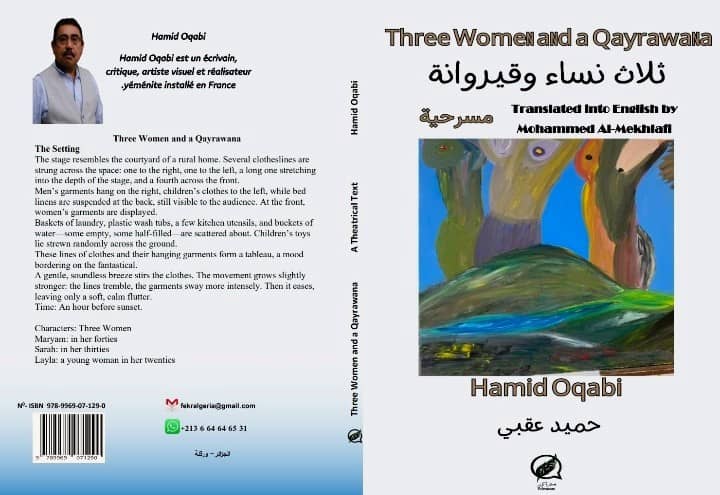
The play (Three Women and a Qayrawana) has recently been published in both Arabic and English. It is the fifth work I have translated into English by the Yemeni writer, author, and theater director residing in France, Hamid Oqabi.
This first edition was published by Fikra Com Publishing and Distribution in Ouargla, Algeria, with the support of Prof. Hamza Qarira, Professor of Contemporary Arabic Narratives at the University of Ouargla and advisor to the publishing house.
The book spans 115 pages and presents the text in both languages, allowing readers to engage directly with the emotional depth and human dimensions of the work.
The play is rooted in a clear human experience, emerging from a simple setting, the courtyard of a rural house. Only a few elements appear on stage, including clotheslines, garments, empty vessels, and scattered children’s toys.
These familiar objects from everyday life are not merely decorative. They are remnants of lives that have vanished, traces of people no longer present, carrying the memory of war in Yemen, absence, and waiting. The space becomes a silent witness to loss and to the emptiness left behind.
The story centers on three women. Maryam is in her forties, Sarah in her thirties, and Laila in her twenties. Each belongs to a different generation, yet they share the same sense of pain and loss.
Their differing ages do not diminish the unity of their experience, nor lighten the weight of the question that haunts them all: what remains after others have departed?
In this play, Hamid Oqabi emphasizes the image before the action. Silent objects, most notably the clothes-drying Qayrawana, are more than mere props. They become active presences that accompany the characters and reveal what lies within them.
The Qayrawana is not a passing detail but part of daily memory and accumulated fatigue, as if it listens and remembers both what is spoken and what is left unsaid.
The language moves seamlessly between poetry and prose, shifting from clear dialogue to moments approaching delirium, from sharp irony to heartrending confessions.
The play does not follow conventional dramatic structures or familiar climaxes. Instead, it focuses on the psychological states of the characters, the woman’s experience of absence and exhausting daily labor, the burden of memory, and the wait for a time that seems endless.
(Three Women and a Qayrawana) captures the weight of everyday life and the deep impact of loss on the human spirit. My translation strives to convey this emotional resonance faithfully, preserving its quiet intensity and weariness without embellishment or adornment.