

Old Sana’a: The Elegance of Women and the Memory of Place
Yemenat
Mohammed Al-Mekhlafi
(One must reach Sana’a, however long the journey may be.) This saying has been passed down through generations, reflecting the unique place this city holds in the Yemeni imagination. It is a city unlike any other.
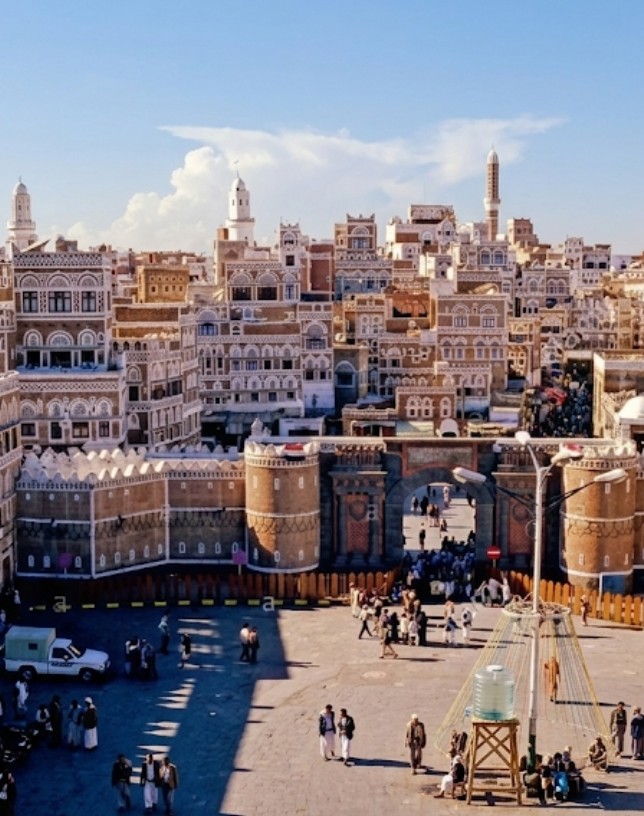
When you set foot in Old Sana’a and stand before (Bab al-Yemen), you feel as though you are crossing into another era. Before you, ancient tightly clustered buildings rise in exquisite harmony, constructed from red baked brick and adorned with white gypsum decorations.
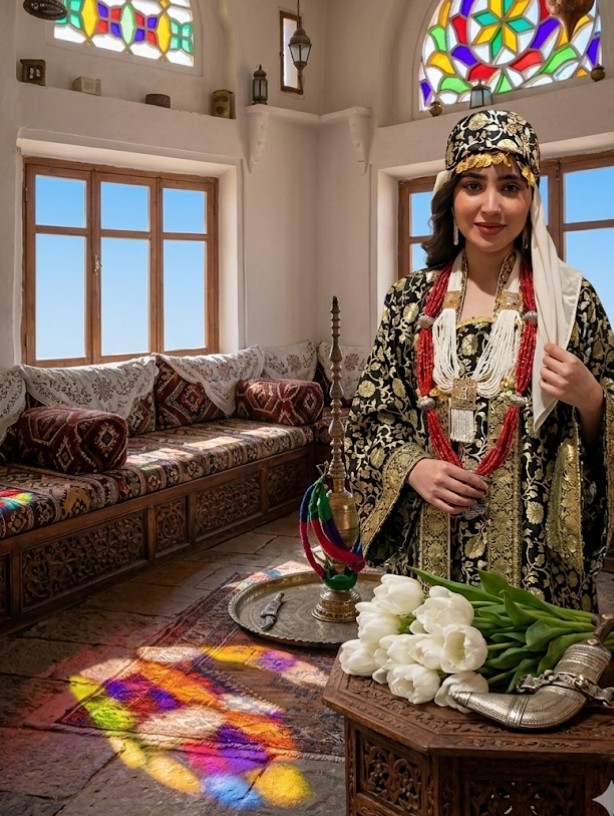
Their windows are crowned with (qamariyyah) stained glass, through which streams of coloured light spill across the walls in a captivating display.
Beyond this historic gate, narrow alleys and bustling markets unfold, where the scents of coffee, incense, and spices drift through the air, offering visitors a living image of a city that has preserved its soul for more than 2,500 years, according to UNESCO.
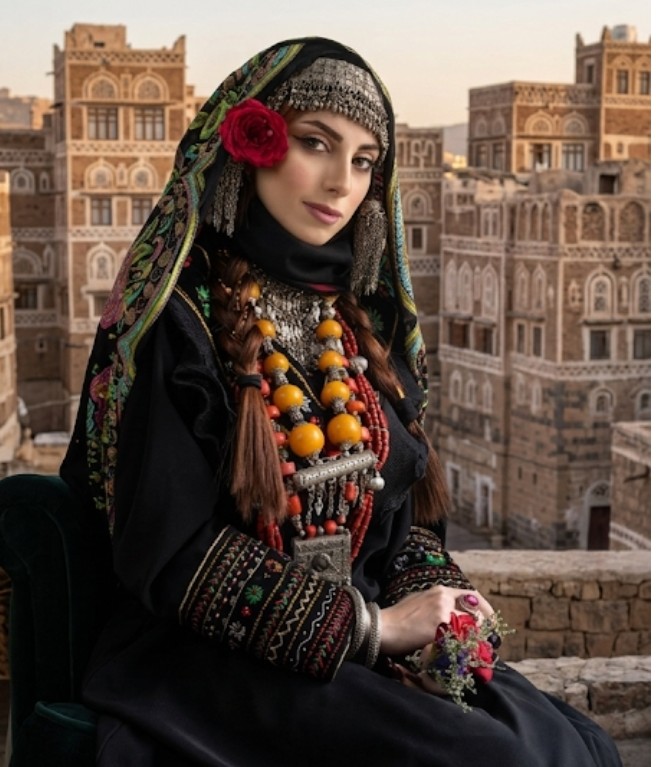
At the heart of these enduring details that preserve the essence of Old Sana’a, traditional women’s attire emerges as one of the most powerful expressions of cultural identity. Through her clothing and jewellery, the Sana’ani woman has carried the memory of place, narrating through colours and patterns a chapter of the city’s social and aesthetic history.

Among the most distinctive garments are (the Sittarah) and (the Mukhmaq), an outer covering for the body. (The Mukhmaq) is the veil that covers the head and face, while (the Sittarah) is a wide, richly decorated cloth adorned with colourful geometric patterns. Together, they embody both modesty and elegance.
In weddings, Sana’ani attire reveals itself in its most magnificent form, as the bride wears a collection of traditional garments that many families still preserve as cherished heirlooms, reflecting Yemen’s deep cultural heritage. Among the most important of these are (the Qamis), the Yemeni crown, and (the Qanba‘ee).
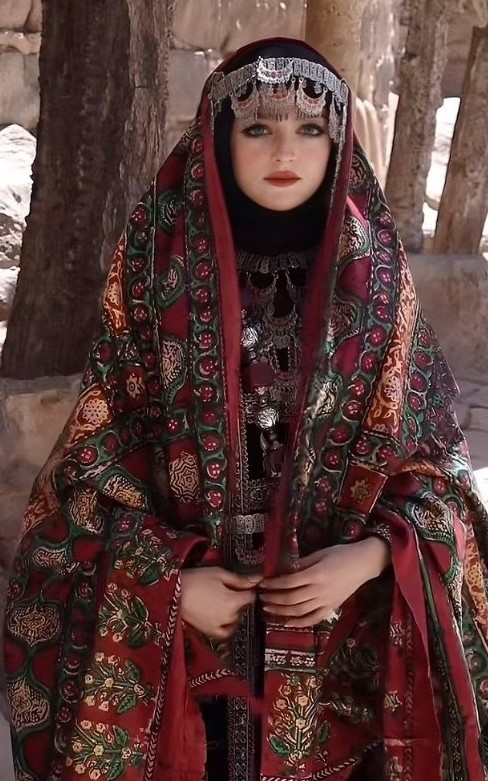
(The Qamis) consists of two pieces of finely woven fabric, richly embroidered by hand with golden thread. One piece covers the head and face and is adorned with sprigs of (shathab), or aromatic rue, while the other forms a wide-sleeved garment that drapes over the entire body.
The ensemble is completed with a necklace of silver and coral, adding a final touch of grace and refinement.
As for the Yemeni crown, it is considered one of the most elegant traditional adornments. In earlier times, it formed part of the bride’s official attire as she moved to her husband’s home. Today, however, it is most often worn when visiting her family after marriage. The crown is set with gold, reflecting both its symbolic meaning and aesthetic splendour.
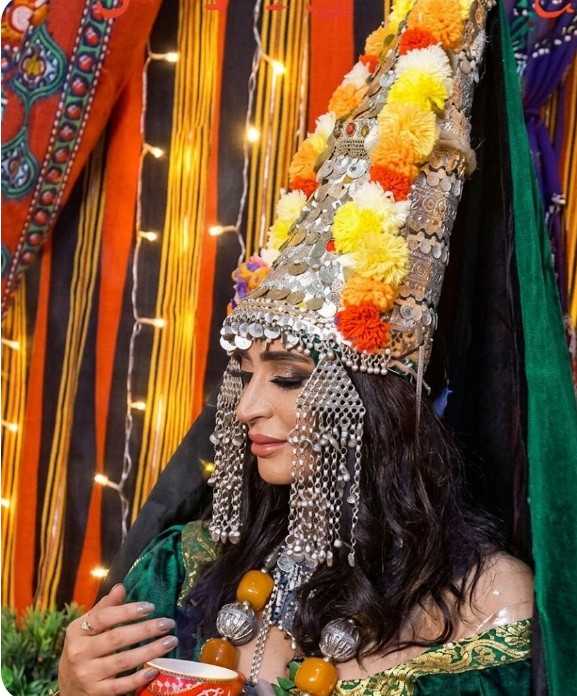
(The Qanba‘ee) represents a more distinctive and private form of adornment. It is a cone-shaped crown studded with gold coins, worn by the bride during her ceremonial visit to her family after the honeymoon period. In Sana’a, it is known as (the Shakmah), and in earlier times it was crafted entirely from pure gold.
Sana’ani dress, particularly in weddings, is distinguished by its remarkable richness of embroidery and harmony of colours. Gold and silver threads are skilfully woven into the fabric, while tones shift between deep and vivid shades, reflecting a refined aesthetic sensibility and a deeply rooted cultural awareness. For this reason, the women of Sana’a have preserved these garments as treasured heirlooms, no less precious than rare artefacts.
The presence of traditional attire is not limited to weddings; it extends to other social occasions, including childbirth. Even today, some women continue to uphold old customs associated with this stage of life. Among these are (the Asbah) and (the Asjah), as well as the preparation of an elevated resting place for the new mother in her room, known as (the Sajaf), arranged using layers of old fabrics.
(The Asbah) is a head and neck covering made of beads, coral, crystal, or silver. It comes in various shapes and colours and is worn after the first fifteen days following childbirth. (The Asjah), also known as (the Samatah), is a multicoloured cloth placed over the head along with ornaments, worn on what is known as the Day of Fulfilment, forty days after childbirth.
As for (the Misr al-Tali‘i) and al-Nazili), it consists of two layers. The first is a light piece worn directly over the head, followed by (the Misr al-Tali‘i), made from a fabric known as (al-Jarz). Its centre is reinforced to maintain its shape, and it is tightly wrapped around the head. Women in Sana’a traditionally wear it on various social occasions such as gatherings, weddings, and during the postpartum period.
Umm Abdulkarim Al-Qadhi, one of the women of Old Sana’a, says that traditional clothing was an inseparable part of her life’s celebrations. She wore it on her wedding day as well as during childbirth-related occasions.
Although deeply proud of tradition, she also follows modern fashion, which she finds lighter and less costly. She adds that old attire carries a distinct charm that reconnects women with their identity and cultural roots, affirming that elegance has always been an inherent part of Yemeni women’s civilisation since ancient times.
The history of traditional Yemeni clothing stretches back to ancient civilisations such as Saba and Himyar, where fabrics were spun and produced locally, then adorned with exquisite handwoven patterns and decorations.
Over successive eras, these garments evolved, shaped by geographical diversity and cultural and commercial exchange with neighbouring peoples. Yet they retained their local character, embodying the authenticity of Yemeni identity.
Sana’a has long been renowned for its textile production and weaving craft. Its women were famous for spinning and handcrafting fabrics, while the city itself flourished in the production of wool, cotton, and linen garments, along with shawls, cloaks, and richly decorated attire. It thus became a major centre for traditional crafts linked to clothing and adornment.
In Sana’a, garments such as (the dara’a), (the mandil), (the mutraf), (the ridaa), socks, trousers, and (the izar) were all produced. (The niqab), worn by women over the eyes, was also common; when it was drawn down over the lower face, it was known as (the litham).
Thus, Sana’ani attire appears as a living archive, preserving the memory of an ancient city and reflecting the beauty of its architecture and the intricacy of its dress. Sana’a remains, no matter how long the journey, a city ever present in history, spirit, and identity.