

In Elegy for Yahya Al-Sinwar
Yemenat
Mahmoud Yassin | Yemeni Writer & Novelist
We will make this occupation reach a state of contradiction and collision with the entire international community. Sleep in peace; they are now where you wished.
If they asked for my blood and my soul, by God, they would have them for your sake. In my life I have never loved anyone with this overpowering, magical hold, as if you, Yahya Yusuf, and I were your brothers who sold you.
A novelist and writer who has long exalted liberalism and its icons, who long wrote critique and scorn of ideologues, yet you, Yahya, have become my ideology. I wish I had stood between you and the bullets of the scoundrels. I wish I had been your Kermanjidi, my brother and my master.
Each evening, while men exchange thoughts about kohl-dark eyes and the forms of maidens, I mind-picture your features in the minutes before martyrdom and I weep. I weep like a widow who has lost the only man who gave her life meaning, like an orphan struck by villains at your funeral until they laid him low, like a samurai warrior who abandoned his commander and was left with nothing but to commit ritual suicide with his haikiri sword and split his belly as apology to the leader who faced an army with a single fist.
I searched every chance for distance that would keep me far from the Muslim Brotherhood, yet you were alone my brothers and my secret organization, and I ask: from where did you draw such daring, my brother? How did you fill yourself with a blend of Hercules’ heart and the mercy of the Prophet Mohammed? How could I ever be like you, even for one minute—the minute that lay between dressing your wound and the tightening of your arm that the bullet had frayed with a broken wire? At that moment it did not occur to you that you were bandaging the arm of an entire nation.
I wish I had been the fourth support beneath the chair from which you threw down your staff, so perhaps I might have had the honor of supporting your final moment, my father.
How can I overcome my fears in the face of empty words and trivialities when you alone possessed the courage to stand alone against the fiercest force I have known since the war of Tarawda? At that moment you embodied for your enemy the inspiring example of his forefather and founder, Dawud, who with his sling stood before Goliath and felled him, and the sons of Israel gained their freedom and the king’s name was David.
I do not know how to encompass my love for you. I cannot find a way to eulogize you. There are no words, Yahya, my brother, my master, my commander. Your disciples and fighters still, to this moment, wrench steel necks and hurl their bodies against the iron of tanks. We could not overcome our sorrow, my lord. But we fight. We fight our fears as individuals, and they fight as superb warriors who have not forgotten the features of their leader as he hurled his staff at a grotesque world to tell it before he died: in the end, humanity prevails.
You dwell in my features, Yahya; you inhabit the edge of my delirium. Is it because, from the depths of my soul, I wanted to resemble you and failed? Is this strange, wild emotion the translation of the distance between a man’s true self and the image he dreams of being? Or is it a vague, baffling sense of guilt as if I could have stood between you and their bullets, yet I vanished, I left you alone, I left you a likeness painted by the brush of a mighty artist who gave humanity the face of a mythical being: the very moment of essential courage, the embodiment of our full humanity and at the same time our impossible ideal, the one we have forsaken as Arabs, Muslims, and human beings.
I return to the song: “O keeper of honor and men, you are our father, the awe of the whole universe.” I listen to it a thousand times and think of you in the morgue: your body laid out, perforated by bullets, yet you perceive in your great limbo that a Yemeni writer loved you as he has never loved his father; he found strength in you as he had never found in his siblings, and wished he had given his body for you, had borne your wounds and the bullets pierced him while you remained, O Yahya. They place your companion in a refrigerator they call “the place of the dead,” while you are the only living one.
I pledge your wounds and whisper into your ear: the monster staggers, my commander, as if you gathered the legacy of legends that fight the monstrous abomination in the histories of nations, in novels and Hollywood films, the moment the hero fixes his golden spear on the beast’s weakest point, struggles with it, gives it the mortal thrust, and dies minutes before it.
You and I and the Lord of the Worlds know what you did. May the vermin remain far from your pure, laid-out body; may the Arabs keep their immortal and humanity keep its last inspiring knight. When my heart tightens, it cries: Yahya. And if death settles at the tips of my veins, my cry is: Yahya.
I no longer find Jean Genet a hero, nor Tolstoy an inspiration, nor even García Márquez’s magical realism and his book and narration “I Lived to Tell” move me after you. You are our magic and our magical realism that can be lived and told. Do you know what you left me personally? Whenever trivialities assailed me and I was about to yield to pettiness and whatever diminishes my humanity, I remembered you, grew ashamed, rose up, and reclaimed my dignity and my humanity.
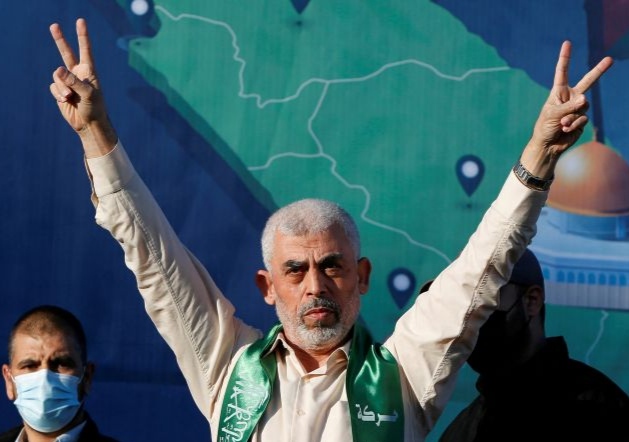
One who loves you must be part of you, O whole of my all. Your words, your speeches, the gray in your temple as in the portrait by Yemeni artist Shahab al-Miqrami placed your gestures into the features of my father and gave me the picture on the day of mourning. I hung it in the corner of my world, and there you stare at me from it: father and brother and king, and whisper from the folds of the painting: do not reconcile. Your collar, Yahya, seemed like a map leading me back to my humanity. Your end is the cipher of my beginning. Your colossal honor suffices for any honorable man who once loved you. You now lie in the morgue, and your enemy sits at the dissection table before the whole world. You felled the abomination, Yahya, and reduced it to a corpse to test humanity’s hybrid nature: how it was born and from which sinful, deranged experiment this monstrosity came.
Did they wound you, my lord? They did not understand that by firing at your body they shot into mirrors that reflected back onto them; for at the moment of your fall you stood tall like a mirror that did not shatter but reflected the world in two faces—on one, a smiling angel; on the other, the grimace of a dying devil.
And here we are, summoning a time this ill-fated region cannot help but recall: ethnic strife borne upon religion. They reclaimed their murderous king, and we reclaimed our brave young man. Does this not please you, O youth now lying in repose?
You are our David, inverted upon the scrolls of the Torah. Their David ceased to be a prophet the moment he turned kingship into a doctrine of killing, the moment he lusted and spied upon the body of his guard’s beautiful wife Bathsheba as she bathed and drops of water slid down her pale skin beneath the shimmer of the moon. From that day on, the oppressed inherited the narrative of the oppressor who had once been oppressed. Their story turned them into killers seeking safety; their atrocities turned us into the slain, seeking justice, virtue, and the faint hope of a justice beyond human instinct.
I see you in the patterns of cigarette butts, on the wall in the features of my late father, his same graying brows, the gestures of his honest anger and healing mercy, in car windows and upon the thin film of water left for me to wash away my sorrows and my frailty.
Long have I kept my distance from the devout, yet you, O pure and awe-inspiring man of faith, are about to make me love them. You are the essence of religion, the cipher of the Mohammedan message, the talisman of myths, the highest tier of all attempts by artificial intelligence to program humanity, yet you transcended it and programmed all humankind upon the duality of justice and mercy.
I weaken, rave, fall, disintegrate, become absurd, collapse, then glimpse your face and regain my composure. I lose my humanity, and I hear you say: “We shall take it from them as tribute.” And I become the tribute and the perfection.
Each evening, my lord, I diminish, yet I am made whole through you. Each night I coil in upon myself like a samurai who has lost his master, and in my core I wish to rip open this Arab existence with your staff, the one you cast to swallow up their falsehoods.
This is what remains for us: the rasping breath of a hero we walked beside yet refused to die with, a verse enthroned upon a seat God granted the enslaved to restore their humanity, a word echoing through the cosmos like a terse, final definition of the path of the wronged Muslim, gasping: Return to them for We shall bring upon them what they cannot withstand.
I swear to you, I pity Hercules who came before you and Alexander the Great who came after. And I ask: before your mountain-like grandeur, your awe, your majesty, what is the meaning of greatness? No before before you, no after after you.
On the threshold between two worlds, where the souls of heroes seethe, I glimpse Alexander’s smile, his gestures of forced confession as he kneels at your feet murmuring: “You have made me ashamed of my deeds.” It is as though in history you are an eternal narrative between two epochs; in metaphysics, an angel; in geography, a hill and a rock upon which armies of enemies were shattered.
I swear to you, my lord, I pity King Arthur in the moment he mounted his steed and drew his sword to stand upon the hill alone, facing an army to defend his people and his land. What remains for him as he watches from his afterlife the world of Yahya, freshly improvised, and the afterlife of Yahya, where he ended the vanity of heroes?
And on the most personal level, Yahya, I, al-Hallaj, whisper before you in humility and gratitude: you gave me so much that I grew ashamed. And because of your daily presence in my mind, every minute, as you repeat, “We will wrench it from them as tribute,” I echo to the rhythm of your final casting: with my whole I hold all your wholeness, O my Jerusalem. You reveal yourself to me until you are in my very self.
I have even begun to commit and pray the five prayers, because you were committed and prayed them each day. To be a version of you for twenty seconds only, that is a long life, an eternity. Twenty seconds only to complete my prayer, to sit on a rickety chair and face an army and complicit worlds and an evil world entire. To face it with a wooden staff and a brave heart that does not sleep, twenty seconds only, and then to depart, content, exchanging a world stuffed with trifles and trivialities.
Do you know, my father? The liberal “enlightened” guardians of human rights took the side of the killer, while the Islamists, accused of all extremism and violence, took the side of the victim. On which side should I sleep? Sleep in peace. God knows His flock. Humanity will, in the end, find its definition of justice that surpasses human drives.
It is as if you spoke in the language of old Vietnam and Japan, brandished Hannibal’s spear and fought with Poseidon’s trident. A herd of imitators of liberalism, addicted to pornographic scenes, try to wound your great legacy, to diminish you in your totality. I feel tempted to violence against them rather than dialogue; they are my personal foes as long as I live. I promise you. What crushes me is the imagined scene of swine in Tel Aviv entering the morgue, turning your pure body, seeing in you what you yourself would have been ashamed to see, O son of ‘Uthman, and I nearly fall into seizures.
Trash striving to defame you, O heir of the three religions, O House of ‘Imran whose daughter the vile accused of sin. They crucified you on the summit of Jerusalem, but you did not cry out like Jesus, “My God, why have You forsaken me?” Rather, you bound your arm and said: “I will not forsake my beaten-down people.”
You are our David who struck down Goliath with a stone. And you are our Prophet Muhammad at the moment of betrayal in Ta’if, stumbling on his wounded body with bleeding feet and trembling fingers, denied the luxury of voicing his human weakness, yet whispering: “O God, I complain to You of my weakness and my lack of resource.” And when reproached in that video with tearful eyes, you replied: “To whom do You entrust me? To an enemy who scowls at me, or to a kinsman to whom You have given power over me?” Tremendous shifts of spirit: at sunset you were the supplication of Ta’if, and the next morning you were the chargers at dawn.
Your kin delivered you to your enemy, yet you held your command. Your enemy caged you for twenty years; you did not waste them in moaning and self-pity but invested them in learning his language, his methods, his strategies. And you left the cell after twenty years to imprison your jailer instead, and made the entire world his court, all humanity witnesses to his crimes.
You turned tunnels into arteries of new life, dens of wounded predators, fiery roots spreading under the monster’s lair, gnawing at it from beneath the earth. And when you stood on the dune of Tel al-Hawa with your rifle and your Kermandit, and behind your ribs the heartbeat of humanity’s last knight echoed—that heartbeat pulsing through the cosmos in suspense and expectation—you advanced alone save for the greatness of your soul, and the universe gaped as it watched what this planet would do at this moment, and with your steps the galaxies chanted: “The earth has brought forth its burdens.”
In that moment you were the red freedom, you were its door, you were the bloodied hand of humanity hammering and breaking the walls of savagery, superstition, and dehumanization. I seek refuge in the light of your face, which illumined the darkness, that I may not stray nor be led astray, that I may not wrong nor be wronged.
It is good that your station does not heed what the ignorant now say. In the end you gathered in your throat Khalid, Salah al-Din, and Qutuz, and from the depths of our history you alone cried: “Mount, O horses of God!”
Your laid-out body, my lord, is woven from the body of Gandhi before the flames consumed him, and between your brows glows the wrath of Che before they betrayed him. In your depths echo the spell, the incantation, the opening lines of the Arab poem: “Let us pause and weep at the memory of a beloved and a dwelling.”
It is the same cry before salvation—salvation wrested from under the rubble, drawn from between dung and blood, birth from the darkness of ruin and the bitterness of leaves, from departure to departure, and the deafness of thorny roads—and in the voice of your poet-daughter of Palestine who was born from your crooked rib, that rib on which Merkava phalanxes and troop carriers and house demolishers broke at the gates of Jaffa:
O my beloved ones, in the chaos of wrecked homes, between rubble and thorns, I stood and said to the two eyes: “Let us pause and weep.”