

Echoes of the Deluge by Abdelhay Korret: Writing from Within the Experience, Not from Outside It
Yemenat
Mohammed Al Mekhlafi
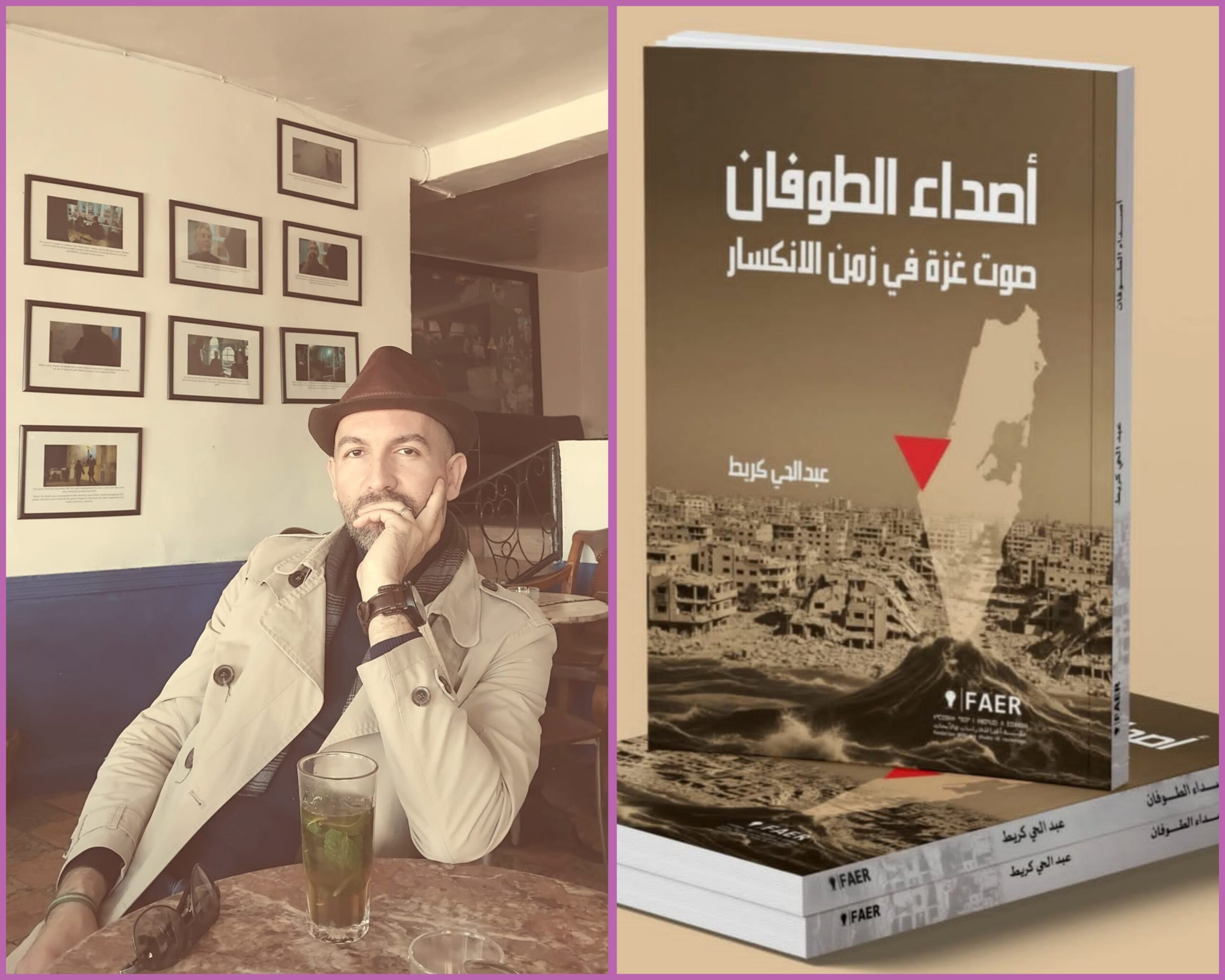
The book (Echoes of the Deluge: The Death of Gaza in an Age of Defeat) by Abdelhay Korret, published by Afra Foundation for Studies and Research in 2025, spans 316 pages and emerges as both an intellectual and emotional document that transcends mere historical documentation.
In this work, the author moves beyond the calm restraint of conventional intellectual writing and approaches directly the harsh reality that Gaza is enduring, writing from within the experience itself rather than from outside it.
Abdelhay Korret, publishing director and editor in chief of Anbaa Express, works in media and cultural research, with particular attention to Spanish literature and cultural dialogue between the Mashriq and the Maghreb. Before this book, he published two works: (Dialogic Windows in Spanish Literature, Art, and Philosophy) (2024) and (Cultural Orbits: The Sun Rises from Morocco) (2025), both of which address cultural and intellectual questions connected to these interests.
(Echoes of the Deluge), however, differs markedly from those earlier works. Here, the author turns toward a mode of writing that is closer to immediate human reality than to broad cultural inquiry.
From the very first pages, it becomes clear that the author is not writing from a distant position. The ideas seem to flow before they are fully settled, and this is occasionally reflected in the rhythm of the text. Yet this should not necessarily be viewed as a flaw; rather, it appears connected to the weight and urgency of the subject itself, and perhaps also to the author’s method of pursuing the idea while it is still forming.
Gaza does not appear here merely as a political issue. Instead, it emerges as a profound human condition that compels the reader to ask: how can the world witness all this and continue as though nothing has happened? The author does not devote himself extensively to interpretation, nor does he attempt to impose a rigid structure upon meaning. Rather, he leaves events exposed as they are, through scattered voices and testimonies, because what is taking place exceeds the capacity of a single reading, or even a single book.
In the first chapter, (Dialogues in the Time of the Deluge), which occupies a substantial portion of the book, this approach appears deliberate. A single voice is insufficient to encompass what is happening; consequently, multiple voices emerge, all revolving around one recurring idea: (defeat).
In one passage, Akram Al Sourani says: (Let me unburden myself from the heart of disappointment. We are not well, and we die every minute) (p. 13). The sentence carries unmistakable emotional weight and feels closer to words spoken under the direct pressure of experience than to a carefully polished literary formulation. The sense conveyed is that the text arises from exhaustion rather than from any desire for ornamentation or rhetorical display.
Elsewhere, the text states: (We began sleeping on the ground… the tent became our home) (p. 18). The phrase arrives almost exactly as lived reality itself, with very little distance between the experience and its expression, and this is precisely what intensifies its effect beyond any elaborate explanation.
Throughout this chapter, certain ideas recur in different forms, and at times the same meaning appears to return without substantial variation. Perhaps this is because the experience itself is too overwhelming to be contained within a single formulation, or because the testimonies share the same essential reality.
As peoples, we grieve for what has happened to our people in Gaza, war, extermination, and displacement, and for the devastating human losses that have scarred both homes and memory alike.
In the second chapter, the rhythm shifts somewhat as the author moves closer to analysis. He discusses the Israeli narrative, the Western position, and Arab silence. The text moves between narration and analysis without settling fully into a single mode.
He writes: (What is called the historical right is nothing but a late ideological construction) (p. 41). Here, the concept of (historical right) appears less as something discovered within history than as something manufactured through discourse itself, taking shape gradually over time.
Elsewhere, he states: (Resistance is not merely a military act, but a state of consciousness formed under the pressure of oppression) (p. 58). In this formulation, resistance expands beyond the military sphere to include consciousness itself and the conditions that shape it.
In a quieter moment, he writes: (What comes after the deluge is not what came before it, not because war changes everything, but because it reveals what had been hidden) (p. 72). The underlying idea is simple yet powerful: what emerges after catastrophe is not entirely new, but rather something long present that has now been exposed.
In the third and final chapter, the rhythm changes noticeably. The author no longer remains within the boundaries of analysis, but moves instead toward a language charged with grief and sorrow, as in the text (Orphaned Gaza… in the Face of Abandonment) (p. 268), where he writes: (Gaza was abandoned, in the dark age / In the heart there is pain, and in the throats there is silence).
What lingers most is the striking paradox of (silent throats). The issue here lies not only in what is happening, but also in what remains unsaid. Silence does not appear incidental or temporary; rather, it becomes so heavy that it enters into the very texture of the scene itself.
The text then shifts into direct condemnation when the author writes: (Gaza is not a wound in their history, but a stain of shame) (p. 270).
At this point, the critical distance narrows considerably. It feels as though the writer no longer concerns himself with the notion of balance, or perhaps no longer considers it relevant. Condemnation increasingly overtakes explanation, while words such as abandonment, silence, collapse, and fall recur insistently, as though circling within the same emotional space.
Elsewhere comes a sentence of remarkable density: (In Gaza, hunger has the taste of blood, and bread bears the form of a martyr) (p. 285). The sentence does not attempt to explain; rather, it leaves its impact directly upon the reader. Hunger and death appear side by side with almost no distance between them, which is precisely what gives the image its emotional force.
In another passage, the author writes: (The child who carried the sack of flour carried behind him the map of a torn homeland). A seemingly small image opens onto a much larger landscape: a child, a sack of flour, and a homeland stretching behind him like an endless shadow without a clear horizon.
In the text (Death Equals Zero… in Gaza), the rhythm becomes calmer, or at least appears to do so. There is an attempt at composure, even if it never fully stabilizes. The author writes: (What is terrifying in Gaza is not the number of the dead, but the normalization of death) (p. 293).
The sentence appears calm on the surface, yet it is harsher than it first seems because it does not focus on death itself, but on its transformation into something ordinary. That transformation changes the meaning entirely.
As for the text (Khan Younis: The Prayer of the South in the Sanctuary of Ashes), the tone becomes different once again, closer to longing, though still shadowed by loss. The author writes: (We used to walk along your shore, writing the names of hope upon the sand before the waves swallowed them).
The sentence feels deeply retrospective, as though attempting to preserve an image of the past before everything changed so irrevocably, as if it were the final remnant of a fading light.
Ultimately, (Echoes of the Deluge) does not seek to present itself as a perfectly complete work so much as it seeks proximity to Gaza itself, with all the tension and instability such proximity inevitably carries. The text moves between testimony, analysis, and emotional intensity, and at times leans more toward emotional expression than analytical inquiry. Even so, it succeeds in conveying the weight of the experience without softening its sharpness or distancing it from the reader.
From my perspective, the value of this work lies in its sincerity in approaching a subject as immense as Gaza. Certain repetitions and moments of linguistic intensity may appear throughout the text, yet these qualities seem inseparable from the nature of the experience being conveyed.
In the end, this kind of writing remains important precisely because it emerges from the heart of the experience, not from a distant position outside it.